WE’RE MOVING!

IMG_3025Dear friends,

Exciting news!

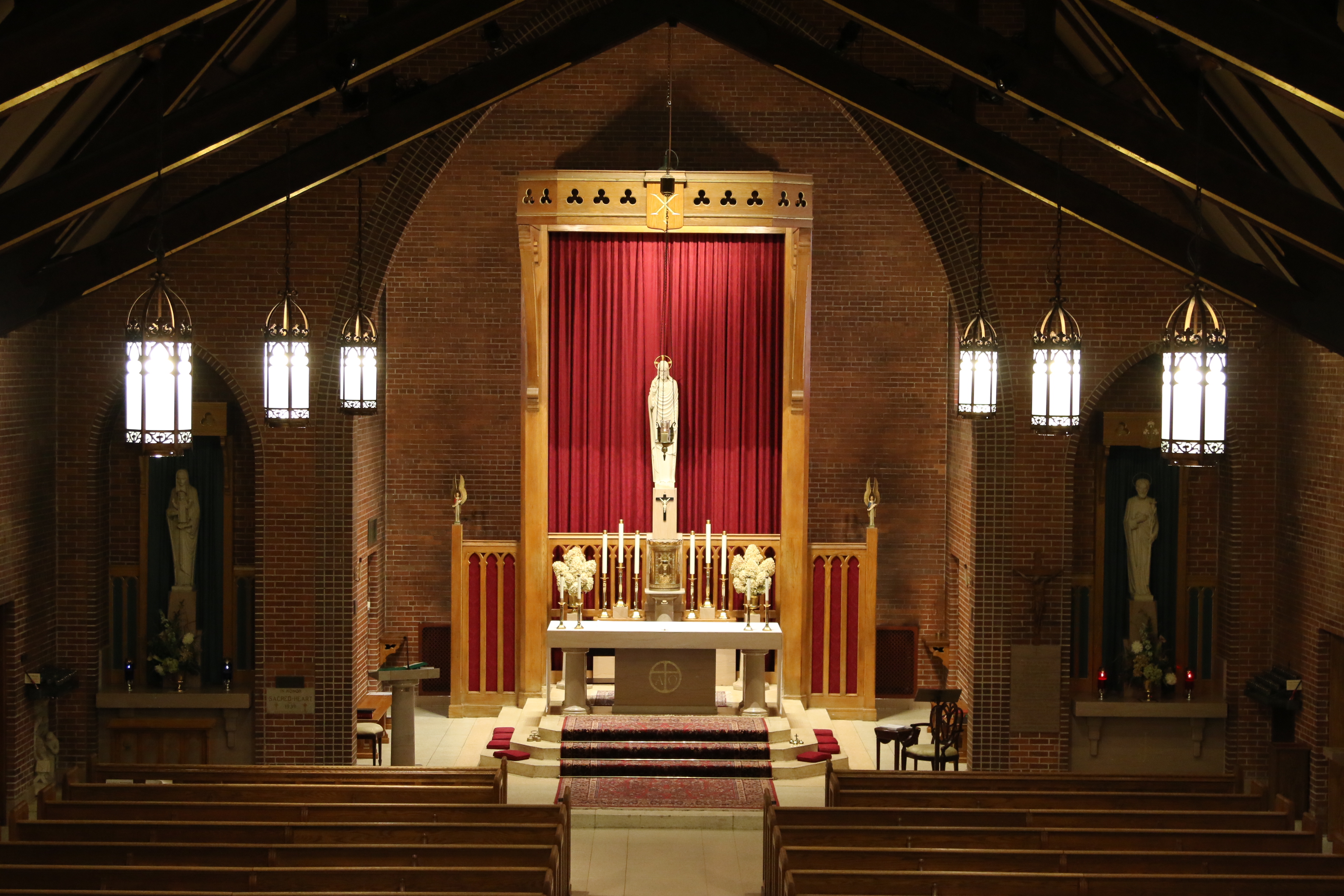
I’m very pleased to inform you of a major change in the life of our community. Beginning on the first Sunday of October (10/4), we will enjoy the hospitality of the people and pastor of Sacred Heart Catholic Church, located at 888 King Street (the corner of King and Huger). Our Ordinariate Mass will be at 9.00AM (Sacred Heart’s Mass is at 11.15AM). One benefit of this move is that it will allow us join forces with our brothers and sisters at Sacred Heart for Sunday School following our Mass. Sacred Heart is a beautiful church, and the pastor, Fr. Dennis Willey, has extended a very warm welcome to us.

In preparation for this move, I invite you to join me Wednesday, 16 September, at 6.30PM at Sacred Heart. This will allow me to “introduce” the church to you, cover some logistical details (parking, etc.) and to answer any questions you may have. We will also pray Compline together before dismissing.

Through the month of September we will continue to offer Mass at our regular time at St Mary’s. All of us, of course, are deeply grateful to the people of St. Mary’s and Msgr Brovey for their generous hospitality these past two years. Now we begin a new season together as we follow God’s call to us.

Faithfully in Christ,
Fr. Allen

Holy Week at Corpus Christi

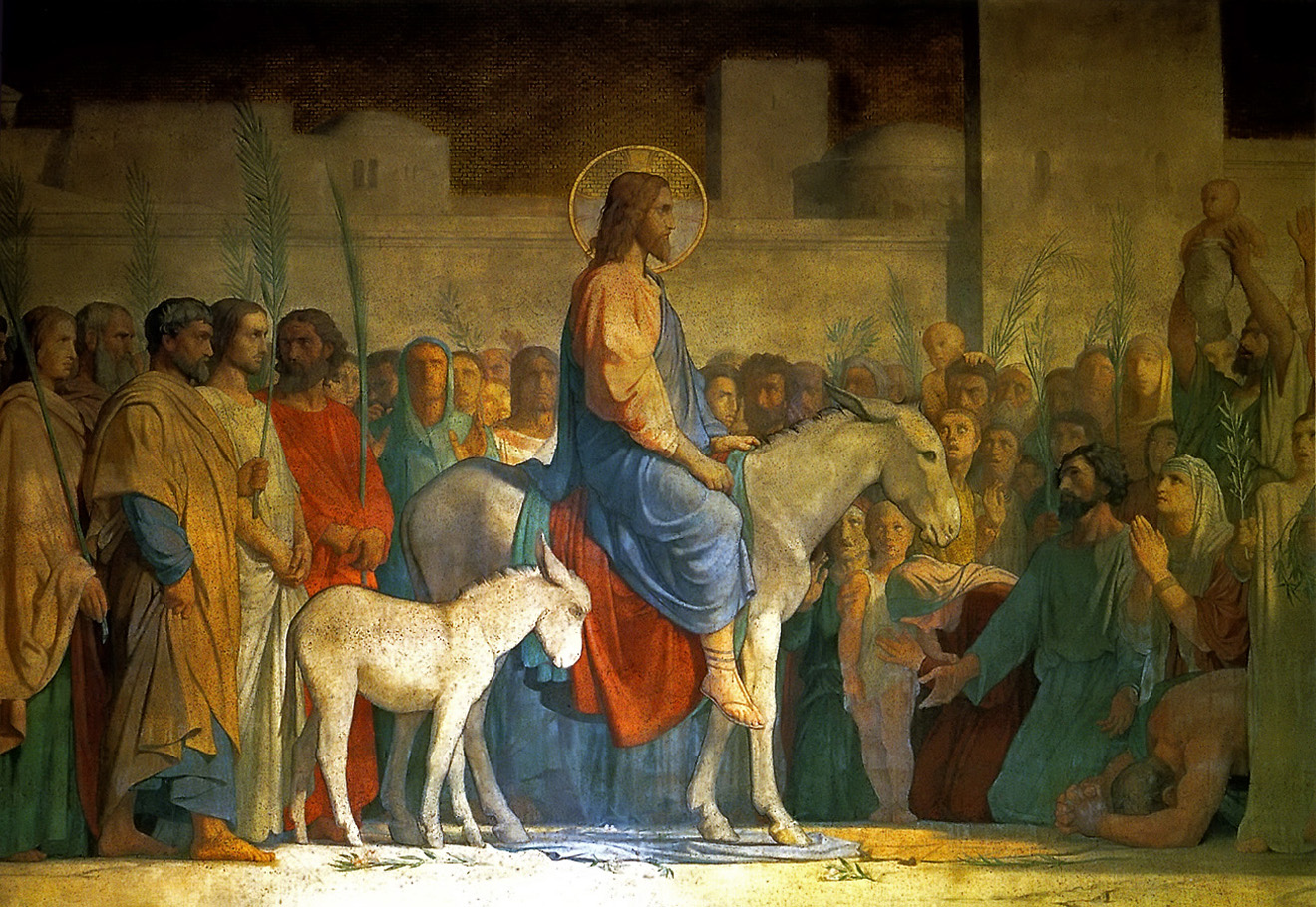
Christ's Entry into Jerusalem by Hippolyte Flandrin c. 1842

Holy Week
Ordinariate Use Masses

+ + +

29 March, 11.30AM
Palm Sunday: Liturgy of the Palms and Holy Mass

2 April, 7.00PM
Maundy Thursday: The Mass of the Lord’s Supper

3 April, 3.00PM
Good Friday: The Lord’s Passion & Mass of the Pre-Sanctified

4 April, 8.30PM
Easter E’en: The Solemn Vigil of Easter 


12 April, 11.30AM
Divine Mercy Sunday
Refreshments & Children’s Easter Egg Hunt after Mass

Top 13 quotable quotes by Pope Francis on sanctity of life

Let us join our hearts to the Holy Father’s in fostering a culture of life!

Carol Glatz's avatarCNS Blog

VATICAN CITY — Top 13 quotable quotes from Pope Francis on the sanctity of life:

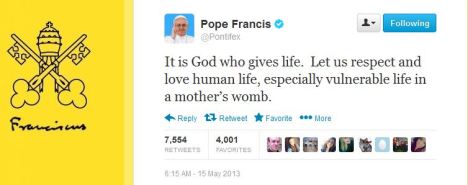
1.

francis life tweet

2.  “All life has inestimable value even the weakest and most vulnerable, the sick, the old, the unborn and the poor, are masterpieces of God’s creation, made in his own image, destined to live forever, and deserving of the utmost reverence and respect.”

Message to Catholics taking part in annual Day for Life in Britain and Ireland July 28, 2013

3. “Let’s say ‘Yes’ to life and ‘No’ to death.”

Message to Catholics taking part in March for Life in France Jan. 19, 2014

MAN AND CHILD HOLD HANDS DURING ANTI-ABORTION MARCH A man and child hold hands during an anti-abortion march in central London in 2007. (CNS photo/Toby Melville, Reuters) (Oct. 30, 2007)

4. “Every child who, rather than being born, is condemned unjustly to being aborted, bears the face of Jesus Christ, bears the face of the Lord…

View original post 1,000 more words

Homily: Holy Family

The Holy Family
Lk 2.22-40
28 December 2014
Fr. Patrick Allen

+ + +

holy familyOn Christmas Eve at the Midnight Mass we heard from St. Luke’s Gospel that when the shepherd’s heard the angel’s announcement they went to Bethlehem “with haste, and found Mary and Joseph, and the babe lying in a manger.”

These first witnesses, these first worshipers, beheld Jesus in the context of a family – a mother, a father, and their newborn Son.  That is why in the Church’s yearly pattern of devotion on this, the first Sunday after Christmas, we keep this great feast of the Holy Family of Jesus, Mary, and Joseph.  And of course in a week’s time we will keep the feast of the Epiphany when our Lord was manifested to the Gentiles in the mysterious persons of the Magi, who, again, discover “the King of the Jews” whose star they had seen in the East precisely in the context of a family.

The family – the normal, human family – is the context in which Jesus is known and must be understood.  And so on this day we are invited to contemplate this image, this icon, of the Holy Family in which the little little Lord Jesus “appears as the center of his parents’ affection and care”.

It’s in this context that we understand that Jesus shared our full humanity, that he really one of us, one with us – not only in the strictly biological sense (important as that is), but in the normal social, developmental, and experiential senses as well.  He grew and matured in the virtues of faith and love just as any child, any many man, ordinarily does – if he does – that is, from his parents.  From them Jesus came “to know the beauty of faith, of love for god and his law… the demands of justice, which are fulfilled in love.”

And it is in this context, the context of our own families, of course, that we come to know him.  We have in our Old Testament and Epistle readings today meditation on and instruction in family life.  Sirach speaks to us of the honor children ought to bear toward parents, especially in their old age.  St. Paul speaks of the gentleness, respect, and loving obedience that ought to obtain within the family.  But, as Pope Benedict once pointed out, the Gospels really contain no discourses, no significant instruction from our Lord, on family life.  However, our Pope Emeritus would go on to point out, they contain “an event which is worth far more than any words: God wanted to be born and grow up in a human family.  In this way he consecrated the family as the first and ordinary means of his encounter with humanity”.

“The first and ordinary means of his encounter with humanity.”  Children will see, or not see, something of God’s tender love in the way they are cared for by their parents.  They will learn the laws and precepts of the Church not so much by, or not so deeply by, explicit lessons as by the example of their parents’ faithful and joyful observance.  Again, is this not what we see in this morning’s Gospel lesson, the Candlemas story of our Lord’s Presentation in the Temple? Mary and Joseph carefully and joyfully fulfilling their obligations as faithful parents according, as St. Luke comments, to what is written in the law of the Lord.

Again, the Mosaic Law stated – and Luke quotes it in our lesson – that the firstborn son is sacred to the Lord, consecrated to the Lord’s service.  However, the child could be “redeemed,” bought back, for five shekels, payable to any priest in the land.  St. Luke is vague about the details, but apparently rather than being redeemed and restored to his parents,  Mary and Joseph actually brought the child to Jerusalem and handed him over completely to God in the Temple.  The word we have translated here as “to present” is the normal word for “to offer” – the same word used to describe the offering of sacrifices in the Temple.

So, you see, in the Presentation, in the offering of the Infant Lord in the Temple, we see already the shadow of the cross falling across Jesus.  This is why he has come after all, Mary’s firstborn Son who is “the firstborn of all creation” as St. Paul describes him, to offer himself, to offer a perfect and pure life of love up to the Father on our behalf, as one of us, the right response to God’s act of love in creation. And our Lord’s faithfulness, his “obedience unto death, even death on the cross,” is rooted and grew to maturity in the context of family – in the careful, intentional, often no doubt inconvenient and difficult, but joyful faithfulness of Mary and Joseph. And then, what do you know, even from his cross, Jesus makes provision for his Blessed Mother, her own soul pierced with a sword of sorrow, placing her in the care of St. John. To his dying breath – and in his resurrected glory, as well – Jesus is a faithful family man. That is, Jesus the celibate man, is to his dying breath a family man, which is important for the single, divorced, widowed, as well as celibate priests and vowed religious to bear in mind.

I don’t think I need here to belabor the point of how important the family is – but precisely because the family is so important, so foundational for the raising of children in the nurture and admonition of the Lord, it therefore all the more important that we do not let it become an idol.  The family is a beautiful means to an even more wonderful end – a saving encounter with the Lord Jesus – it is not an end in itself.

Because family is hard.  It is difficult to maintain a marriage, to raise children as Christians in a culture that is seemingly everyday more hostile to and corrosive of the virtues and priorities of faith.  And when we allow family to become an idol, well, it just can’t bear the weight.  Children will disappoint, spouses will stumble, parents will fail.  I won’t even mention the scourge of siblings!  And if a shiny happy family is our ultimate end, our goal, our idol, then we won’t know what to do when the problems come, as they must.

So you see, the family is a school for the virtues of Christian faith because the family so desperately needs the virtues of Christian faith.

Blessed John Paul II put it this way: “The Church is deeply convinced that only by acceptance of the Gospel are the hopes that man legitimately places in marriage and in the family capable of being fulfilled”.

And to “accept the Gospel” is to accept, and to embrace, and to cling to the truth that God in Christ has done for us what we cannot do for ourselves; that Christ is our righteousness; that we are the objects of God’s love and mercy and patience and forgiveness.  And having accepted the Gospel, the family is, again, “the first and ordinary” context in which we learn to extend that same love, mercy, patience, and forgiveness.  Which is to say, that it is the first and ordinary means, the first and ordinary location, of our daily conversion to Christ, so that the image and likeness of God, our true humanity, is restored in us.

In the Holy Family, in the Babe at its heart, we see that perfect image and likeness.  That family was not above the trials of normal family life.  Right from the beginning, like any parents, and each in her and his own way, Mary and Joseph had to make the decision to receive this child as a gift given and intended by God, with all the life-altering burdens that would normally entail, and the special burdens this particular child would entail.  Joseph in the dead of night leading his wife and child home and kin to Egypt.  The sword that would pierce Mary’s own heart, just as the prophetess Anna said, as she kept her station at her son and Lord’s cross.

But by their faithfulness, by the burdens they would carry, by the love they gave one another, this Babe grew, as St. Luke tells us, and became strong, filled with wisdom; and the favor of God was upon him so that, when his hour came, he would fully and perfectly present himself, offer himself up to his Father in heaven, and our salvation would be accomplished.  That’s what a family – faithful, joyful, holy – can be and do.

Jesus, Mary, and Joseph, save souls! And renew the Christian family!

+ + +

Homily: Christmas Day

Pisano-Andrea_Madonna-col-bambino_Opera-del-Duomo-11

Christmas Day 2014
Fr. Patrick Allen
Cathedral of St. John the Baptist

+ + +

The Word was made flesh and dwelt among us.

There’s a 17th-century English Christmas carol – more of a hymn, really – that one doesn’t often hear, which is just as well really, called “Let all that are to mirth inclin’d.” Sometimes you hear it as “All ye that are to mirth inlin’d.” And you can hear in it the English Puritan critique of the celebration of Christmas. When the Puritans came in to their ascendancy they would actually outlaw the celebration of Christmas, both in England and New England as well. The first stanza goes like this:

Let all that are to mirth inclin’d,
Consider well, and bear in mind,
What our good God for us has done,
In sending his beloved Son.

You can hear their concern that the mirth, merriment, and revelry of a traditional Christmas celebration might detract from the sober meditation on the true theological import of our Lord’s Incarnation.

But of course the critique expressed in the carol has the truth of the matter the wrong way around. It is not that mirth detracts from Christmas, but that Christmas, understood and entered into aright, produces mirth, which goes along with that fruit of the Holy Spirit which is joy.

“All that are to mirth inclin’d.” I hope on Christmas morning that’s all of us – that filled with the joy and fun (two different things) of faith and family and friends and – yes! – toys and treats and wrapping paper and carols, all of it: the whole kit-and-kaboodle of Christmas – that all of us leave melancholy and cynicism behind and are, as the carol says, “to mirth inclined.”

Because as we have heard again in today’s Gospel, The Word was made flesh and dwelt among us. Because this day, the birth of this Child, ought to change us – ought to fill us with joy to the point of laughter.  As the Sussex carol – another and much better old English carol – has it:

On Christmas night all Christians sing
To hear the news the angels bring.
News of great joy, news of great mirth,
News of our merciful King’s birth.

The birth of Jesus is good news, glad tidings. Mirth, merriment, laughter – if we’re doing Christmas right, that ought to be the result. Which is not to say that life’s griefs and sorrows – yours and mine personally or the world’s in general – have magically disappeared, but rather that the Word was made flesh in this Christmas Child, and so Eternal  Joy and Love, “true rapture, noblest mirth” have entered in to this world “fast bound by sin and nature’s night,” and grief and sorrow are being swallowed up, transformed and redeemed from the inside. Joy has entered in.

Someone on the Facebook brought to my attention the other day an article by a theologian who (and to be fair, otherwise does very fine work) claimed very bluntly, and I thought somewhat condescendingly, that she did not “do ‘Christmas’” with its parties and wreaths and tacky lights, but rather observed “the Nativity of our Lord.” Well, I don’t suppose she hung a stocking, but had she, she would have gotten a well-deserved lump of coal.

Because the Nativity of Our Lord is a big, happy, mirthful mess. It calls forth at the same time silent awe and loudest praise, because heaven and earth are joined together in this little child, and the world is turned upside down. The Nativity is profoundly, richly, messily earthy rather than starkly and sedately spiritual: the child was born on the floor of a barn, after all; there were poor rustic shepherds imposing themselves on the just-delivered Mother and Child; myriads of shiny angels singing loudly. There was nothing particularly tasteful about it, but rather the Word became flesh, and the joy of the Lord exploding among us, and exploding the bounds of good taste.

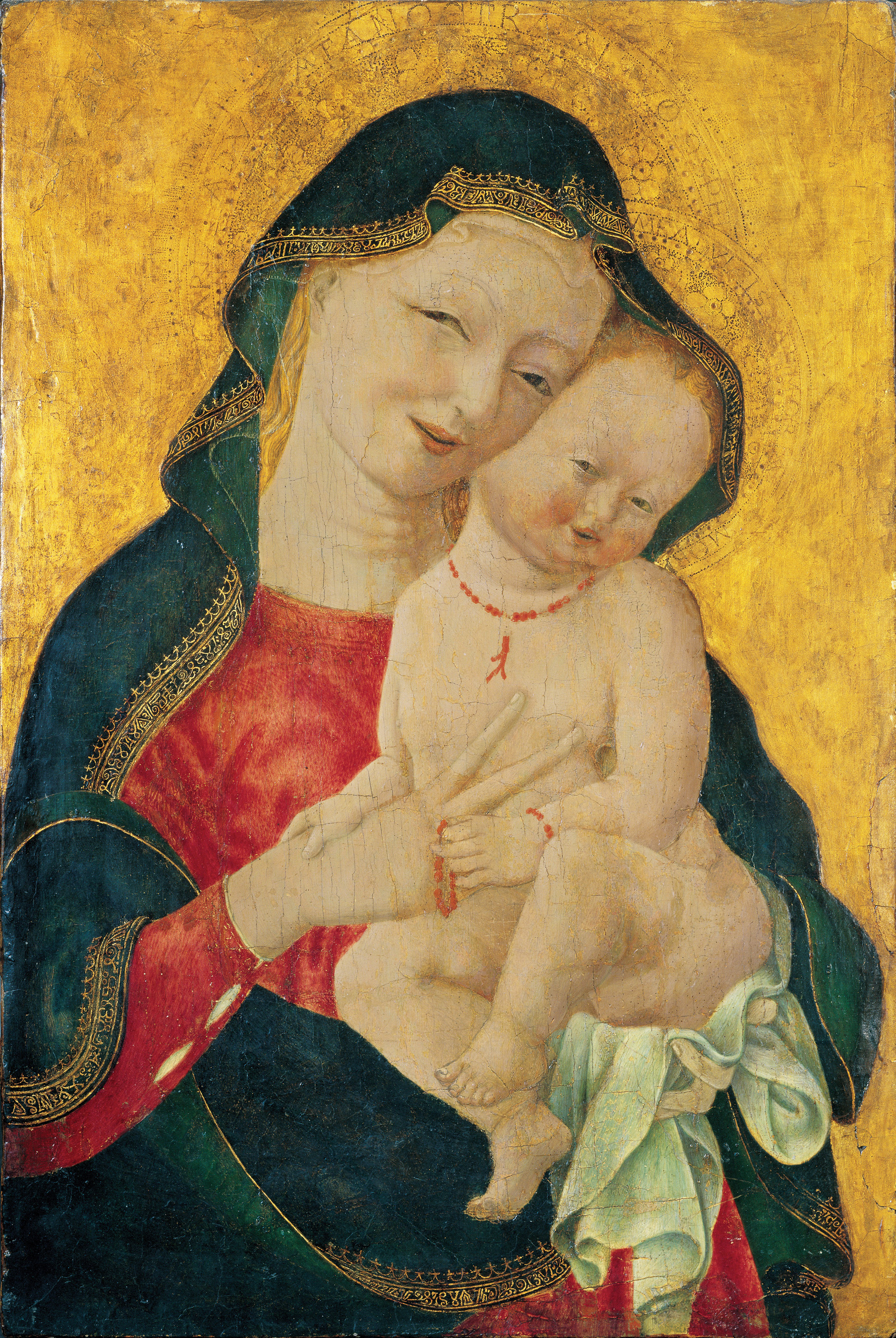
N001This was brought home to me in a new and happy way this Advent.  There is currently exhibited at the National Museum of Women in the Arts in Washington D.C. a massive exhibit of Renaissance and Baroque depictions of our Lady called “Picturing Mary.” I haven’t been able to go and see it in person (yet!), but I’ve enjoyed looking at the catalogue online and reading about it.

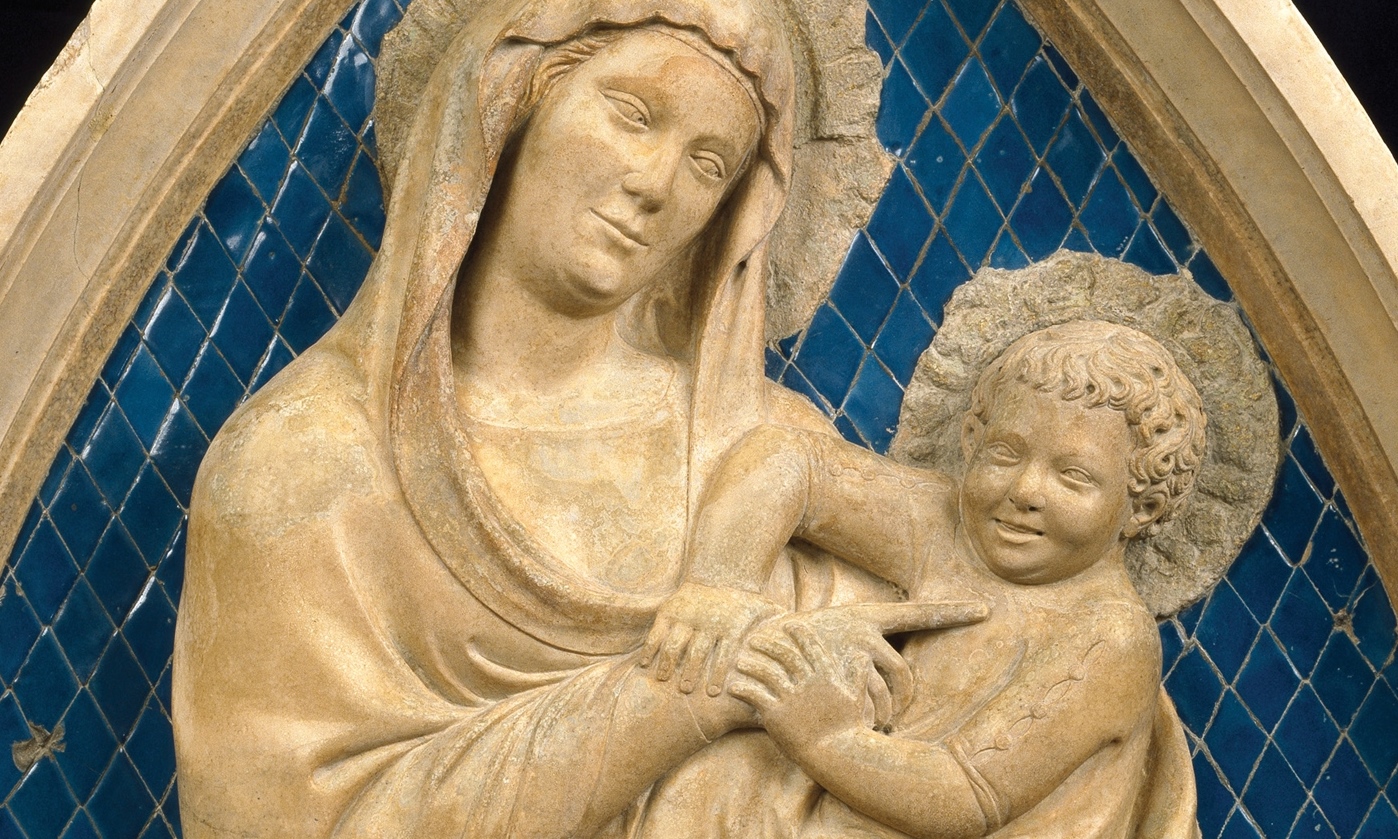
The masterpieces exhibited cover all the themes of the Church’s Marian art and devotion we expect: Our Lady presents her Divine Son for our adoration, she gazes loving and adoringly at him in his manger, she nurses him. But in two of the works – a 14th century bas-relief sculpture and a 15th century painting – Jesus is held in his Mother’s lap, head thrown back and mouth wide with toddler giggles, and seems to be, as one observer put it, “fighting a losing battle against an onslaught of motherly tickles.” They are both, he said, “in an ecstasy of whimsy.”

These works capture and drive home in a wonderful way the reality of God’s all-the-way down, radically complete assumption of our true flesh-and-blood humanity to himself in Jesus Christ, the son of Mary who is God the Son. The Word was made flesh and dwelt among us, and she tickled him. God takes on our human nature, heals and elevates it, so that all of our good things, even a Mother-and-Child tickle fight, can become “places where we encounter the Lord and his love.”

Gabriel Torreta*, a Dominican friar, pondered these rare depictions of our Lord and had this to say:

[They enable] the beholder to experience in a dim but real way the splendor of Christ’s perfect joy that is constantly hidden in plain sight in the Gospel texts. We can laugh with the giggling, writhing Christ-child because we know that this be-tickled body is the same body that he will offer freely out of love to go hungry, to walk all up and down Israel, to preach the good news, to heal the sick and the blind, to suffer injustice, to be scourged, to be crucified, to die. The same body that is Jesus’ on the cross is on display in these two lovely images; the same humanity is what makes both possible. And in the resurrection, this same body, this same humanity, has risen from the dead and has become all humanity’s path to heaven.

So let us rejoice. The Word was made flesh and dwelt among us. May the glad tidings of Jesus’ birth melt our hearts with joy and even laughter. And filled with joy of our Lord’s Nativity, of Christmas,  may we all be more and more “to mirth inclin’d.”

Merry Christmas!

+ + +

*This entire homily inspired by Torreta, here: http://www.dominicanablog.com/2014/12/10/did-the-virgin-mary-tickle-the-baby-jesus/

Also Jody Bottum here: http://www.thepublicdiscourse.com/2014/12/14206/

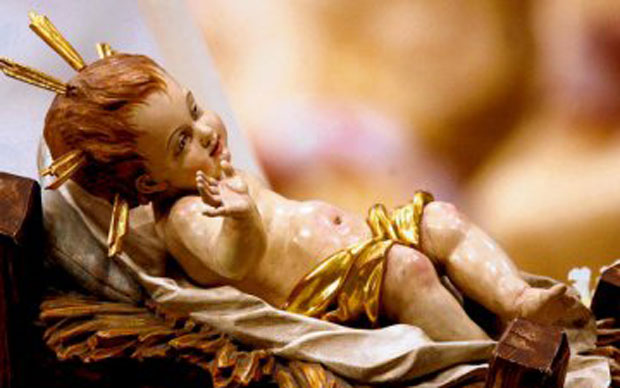
Bambinelli Sunday!

bambinelli

Each year on the Third Sunday in Advent (14 December – “Gaudate Sunday”), children in Rome gather with their families in St. Peter’s Square for Benedizione del Bambinelli.  The children bring with them the Bambinello—the Christ Child—from their family’s Nativity scene.  At the noon Angelus, the Pope blesses the children, their families, and the figurines they have brought.  This Sunday we will unite our hearts with the Holy Father’s and the families gathered with him for the blessing of our own Bambinelli.  Bring your Christ Child on Sunday, and the children will present them for a blessing by Fr. Allen at the conclusion of Mass.

welbornCheck out Amy Welborn’s wonderful Bambinelli Sunday children’s book, with beautiful water color illustrations by Ann Kissane Engelhart.

The blessing of the “Bambinelli” as they are called in Rome, reminds us that the crib is a school of life where we can learn the secret of true joy. This does not consist in having many things but in feeling loved by the Lord, in giving oneself as a gift for others and in loving one another. Let us look at the crib. Our Lady and St Joseph do not seem to be a very fortunate family; their first child was born in the midst of great hardship; yet they are full of deep joy, because they love each other, they help each other and, especially, they are certain that God, who made himself present in the little Jesus, is at work in their story. And the shepherds? What did they have to rejoice about? That Newborn Infant was not to change their condition of poverty and marginalization. But faith helped them recognize the “babe wrapped in swaddling clothes and lying in a manger” as a “sign” of the fulfilment of God’s promises for all human beings, “with whom he is pleased” (Lk 2: 12, 14).

This, dear friends, is what true joy consists in: it is feeling that our personal and community existence has been visited and filled by a great mystery, the mystery of God’s love. In order to rejoice we do not need things alone, but love and truth: we need a close God who warms our hearts and responds to our deepest expectations. This God is manifested in Jesus, born of the Virgin Mary. Therefore that “Bambinello” which we place in a stable or a grotto is the centre of all things, the heart of the world. Let us pray that every person, like the Virgin Mary, may accept as the centre of his or her life the God who made himself a Child, the source of true joy.

–Benedict XVI, Benedizioni del Bambinelli 2009

benedizione

Sermon: Christ the King (A)

B16, XRCHRISTUS REX (Yr A)
Mt 25.31-46
23 Nov 2014
PSA+

+ + +

Today is the last Sunday of the year, liturgically speaking. Next Sunday is of course the first Sunday of Advent, and we will begin our joyful preparation for the celebration of our Lord’s Nativity, and annual pilgrimage of grace, ever ancient and ever new, will begin again.

Advent, the beginning of our liturgical pilgrimage, is about preparation, expectation – but today, this last Sunday of the year, is about consummation, completion, fulfillment – an end attained.  And this Sunday is set aside by the Church as “Christ the King Sunday.” Or, more properly, the Solemnity of Our Lord Jesus Christ, King of the Universe.

This feast was proclaimed in 1925 by Pope Pius XI. And done so in the face of the growing totalitarian claims of the secular state. Pius looked about him and saw what was happening in Italy with the rise of Mussolini, and he looked across Europe and saw the Bolshevik revolution in Russia, and in the face of both Fascism and Communism – opposite sides of the same statist coin – Pius proclaimed this great feast, and by it proclaimed that Christians are citizens of another and eternal country, and the allegiance claimed by any and every earthly state is relativized by, conditioned by, and actually absolutely trumped by the claims of King Jesus and the rights of the Church. And also, for us citizens and subjects, that the allegiance we pledge is always “under God” and the judgement of Christ the King.

Christ the King – who reigns now by his Spirit in our hearts, who reigns now by his law of love and gospel of grace preserved and proclaimed in and through the Church, and whose reign will one certain and great day be fully realized among us, fully consummated among us. When, as we have heard in this Gospel lesson, the Son of man comes in his glory, and all the angels with him, [and] will sit on his glorious throne – and all the nations will be gathered. That coming and great day when his will will “be done on earth as it is in heaven.”

This Feast of Christ the King reminds us of all that – not as an abstraction to be filed away until this same Sunday next year, but as a present truth, a fact to understand and reckon with for the every day ordering of our lives. “Thy kingdom come, thy will be done” is as much, actually more, about what happens or should happen today, than as it about what will one future day be the case.

So what does the reign of Jesus and our subjection to his coming kingdom mean? After all, times have changed. We don’t call Jesus “Lord” in the face of absolute and even divine claims by some emporer off in Rome, nor beneath the crushing yoke of fascist or communist statism. Which is not to say that we don’t yet have the need for serious and sustained political witness and, in some cases, even resistance – we do, as events here in South Carolina just this past week should have reminded us. But we find ourselves, and gratefully so, in what is, still and all, a democratic republic.

And yet…we have our own rivals to King Jesus. Pius XI was defending human dignity against the encroaching claims of the state through fascism and communism, but there was also in the air another threat to the faithful, another “ism” in the air.  This was not a statist threat so much as an individualist, voluntarist threat, a cluster of error which Pope Leo XIII, writing in 1898, called “Americanism.”

Now, that’s a long and complicated story, but one writer very briefly summed up the issue this way:

One set of condemned ideas concerns ranking natural virtues above supernatural ones, along with a division of virtues into “passive” and “active” that gives preference to the latter as more suited to modern times [And what could be more American than esteeming the active over the passive virtues?]. The Pope says this fosters “contempt … for the religious life” and the disparagement of religious vows.

Turning to the origins of Americanism, Leo XIII says it reflects a desire to attract to the Church “those who dissent.” Central to it, he adds, is the idea that the Church … must “show indulgence” to new opinions, including even those that downplay “the doctrines in which the deposit of faith is contained.”

Leo XIII’s reply is that how flexible the Church can and should be is not up to individuals but rests with “the judgment of the Church.” Opposing this orthodox view, he notes, is the modern error that everyone could decide for himself, inasmuch as the Holy Spirit today gives individuals “more and richer gifts than in times past” — no less than “a kind of hidden instinct” in religious matters.

Well, what can we say – the more things change, the more – and the more intensely – they stay the same. Just the week before last, at the USCCB meeting, the bishops received a report concluding a three-year study of the opinions of a cross-section of Catholics.

“They feel completely Catholic even while disagreeing with the Church. We often heard ‘the Pope is entitled to his opinion’,” … “They agree to disagree with the Church” Archbishop Thomas Wenski of Miami stated,

So, not fascism or communism, but Americanism – me, and what makes me feel good, and as for the things that don’t make me feel good, well, the Pope is entitled to his opinion.

Too often, we approach the Faith in good, modern American fashion: as shoppers – and, we implicitly presume, the customer is always right, our desires and feelings self-validating. What Leo XIII called Americanism is really a manifestation of contemporary consumerism – which unites Democrat and Republican alike – but applied to religious and spiritual matters.

All of which is only to point out, as was made plain in this morning’s gospel, that it shall not be so – is not so – among the subjects of Christ the King, who are even now being formed into the image of their King.  And Jesus is not a shopper, a consumer, but rather a Giver who takes the form of a servant, a Lover who gives himself to be consumed.

And he reigns – not as some gold-bedecked and besotted monarch, but as hungry and thirsty, alone and unclothed, sick and imprisoned, a scarecrow king nailed to a cross. And his subjects, being conformed to him, are not shoppers, they are givers, not because they are of superior and more generous moral fiber by nature, but precisely because in their need, in their poverty, they have received grace, and that has changed them.  They have learned to receive, and so learned the value of passive and active virtues alike, which makes them docile, tractable subjects, who pay their tribute, honor and adore their King, by serving not themselves but the least of his brethren.

And, in point of fact, that is how they may, and one great day will be, distinguished as his subjects – not how they become his subjects, which is by his grace, but the sign that they are his subjects, which is their gratitude.

Their passport, our passport – is love: love in the Name of the King who first loved us. The King who saw us poor and miserable, and then laid aside his divine rights, and became one with us, for us – to exchange our poverty and misery for the riches of his grace, and the wonders of his love. The King who calls his subjects “friends,” and seeing them – seeing you and me this morning – hungry and thirsty, gives himself, his Body and Blood, to be consumed. The King of Love whose glory is the cross, the King of Love who is coming.

In the meantime, charity begins at home. Let us love him, by loving one another. Even so, come quickly, Lord Jesus.

+ + +

Sermon: 22 Trinity (OT 33-A)

22 Trinity (OT 33a)
Mt 25.14-30
16 November 2014
Fr. Patrick Allen

+ + +

One of the problems with being a priest is that you never get to hear sermons, only preach them. But I do remember hearing sermons, and I know there was a particular genre of sermon which I did not particularly care for – that in which the homilest dwelt interminably on the hidden meanings of the Greek and Hebrew obscured by modern translations.

Well guess what… this is one of those sermons!

Because this morning’s Gospel presents an interesting (at least to me!) case. This is, famously, the “Parable of the Talents.” Our English word “talent,” meaning an innate ability or natural endowment for some skill or task, actually comes to us from this parable – and this applies in the other languages of historic Christendom as well. That meaning of “natural aptitude” became pretty well fixed in the West by the middle 1400’s through, of course, the Church’s use of the Latin Vulgate – St. Jerome didn’t attempt to translate but simply transliterated the term – and the vernacular preaching, teaching, mystery plays, and so on that used the word.

So our word “talent” comes to us from this parable, but we tend to read our word, and its meaning, back the other way – back into the parable. And that’s not surprising. In God’s mysterious providence, we all have gifts, abilities, skills, or even just plain material wealth, that we are given in order to share; they are not for ourselves alone, and they are certainly not for squandering, for wasting, for burying in a hole in the ground as in the case of the wicked and slothful servant in the parable. These are, again, gifts – and that means they are to be used in accord with the wishes and intentions of the Giver. Which is absolutely true. And so, this parable is about stewardship, the proper use of time, talent, and treasure, right?

Well, all of that is true and good – and important. But it is really only a secondary application of the parable’s meaning. We hear “talent” and can’t help but think “aptitude” or “ability.” But of course, the word didn’t carry that meaning when Jesus first spoke the parable, and none of St. Matthew’s original readers would have heard talenton and thought “ability” or “aptitude” – it just didn’t carry that connotation. No, the immediate impression on the mind when those original readers read five, two, or even one talent would have been of weight, or heaviness.

Because a talent was first of all a measure of weight, a heavy weight. It wasn’t so much a unit of currency, a coin – like the denarius we so often run into in the Gospels. So we may think of the British pound – which is more formally a “pound sterling” because, way back in the mists of time, it was backed by, it represented, a pound of silver.

But when Jesus tells this parable, the talent isn’t some species of legal tender that represents some precious commodity somewhere else. No, “it is what it is” as the football coaches are always saying on ESPN. So we shouldn’t think of coins, but rather of ingots – big chunks of precious metal. A talent was about 80 pounds. So, again, weight – leave-a-dent-in-the-ground heaviness – these are the impressions generated by this word and this story.

And in the Hebrew mind, weight and heaviness would have brought up an immediate association which we are not likely make – namely, the greatest weight, the heaviest thing of all: the glory, the kavod, of the Lord.

Kavod is the word used in the Hebrew scriptures to refer to God’s glory. Kavod gets translated into Greek as doxa – as in “doxology,” and into Latin as gloria. Both these terms carry the idea of light, or luminosity, but the basic meaning of the Hebrew word is weight, heaviness: The Lord God – his presence, his reality, his love – is heavy, weighty. We think of God’s glory as shining; the Hebrew people thought of it as heavy and pressing down – not in frightening, oppressive sense, but in the sense of substantial and real.

St. Paul tries to get this idea across in his second epistle to the Cornithians, when he promises them that whatever their “momentary afflictions,” there was stored up for them in heaven an “eternal weight of glory.”

And the kavod, the glory, of God was not just an abstract theological concept – it was a present reality, and to be found in a particular place – in the Temple, in the Holy of Holies, and very specifically resting upon the golden cover of the Ark of the Covenant, between the golden cherubim, which was called the Mercy Seat. That’s where God’s heavy, weighty, glorious presence was.

So we may think of the 99th Psalm: “The Lord reigns, let the people tremble; he sits enthroned upon the cherubim.” Or in the book of the prophet Isaiah, where the prophet prays, “O Lord of hosts, God of Israel, enthroned upon the cherubim, you are God, you alone.”

And perhaps you remember that the Holy of Holies was entered only one day in the whole year, on Yom Kippur, the Day of Atonement, when the High Priest entered and sprinkled the blood of a sacrificed bull on the mercy seat to make atonement for the sins of all the people. It was there that forgiveness, mercy, was to be found – that’s where it happened. The weight, the heaviness, the dense reality – the glory of God – is then this: to have mercy, to forgive sins.

And here we may recall when God revealed himself to Moses and proclaimed, “The Lord, the Lord, a God merciful and gracious, slow to anger, and abounding in steadfast love and faithfulness, keeping steadfast love for thousands, forgiving iniquity and transgression and sin.”

“Merciful and gracious”: that is God’s substantial glory.

This changes the way we think of our Lord’s parable, doesn’t it? When the master lays these great weights on his servants, we shouldn’t think – at least not first – of time, talent, treasure, and the stewardship thereof, but of God’s mercy, toward sinners. We should think of a true participation, as Fr. Robert Barron has said, “in the weight of divine love.”

And receiving mercy changes us – at least it ought to. To receive mercy is to become merciful; to have been forgiven makes us forgiving. This is what is meant by the “investments” of the first two servants – the weight they have received multiplies in and through them as they “spend,” so to speak, their talents – more is added, it just keeps getting heavier, just as God’s mercy multiplies in and through those who have received it, and then share what they have received.

And the problem with the third, timid servant, who buried his talent, is not that he was a bad venture capitalist, but that he doesn’t understand the nature of what he has been given. And the thing about mercy, the thing about love – is that it can’t be possessed, it can’t be hoarded; you can only have it by sharing it. Or maybe we can put it this way (and this is difficult – we’re trying to tie a bow around the ineffable, which I suppose is why our Lord taught in parables): God’s mercy, his love is not a thing, a commodity. It is instead something living and active; it is something that happens – so you can’t have it, but you can participate in it. It is not a cup of water you can hold in your hand, but a mighty rushing river into which you may jump and be carried away.

And this makes sense of the master’s seemingly harsh words: to every one who has will more be given, and he will have abundance; but from him who has not, even what he has will be taken away. This describes not so much a judgement inflicted but rather the dynamics of love: if you’re not giving it away, you won’t have it; and if you’re giving it away, then you have more.

The third servant not only misunderstands the gift, he misunderstands the giver: Master, I knew you to be a hard man… , he says. And yet the master has shared a tremendous gift, entrusted to him a great weight of wealth.

And in fact, to jump back out of the parable, the Gift and the Giver are the same, aren’t they: “God is Love,” St. John tells us. God the Holy Trinity is an eternal communion of self-giving love, and God reveals himself, his heavy, weighty glory, in Jesus Christ, who empties himself, and offers himself, gives himself to and for us on the cross – so that, loving one another, we may have a share in, a participation in, God’s own eternal life of love.

+ + +