Homily: Ordinary 17 c

1024px-Prayer_JesusSunday, Ordinary 17 – c
Lk 11.1-13
28 July 2013
St Mary’s
Fr. Patrick Allen

These last couple Sundays and for a few more yet to come, we are reading through a section of St. Luke’s Gospel in which the evangelist has brought together a kind of compendium of our Lord’s teaching on discipleship. And in terms of the characteristic activity or, we might even say “lifestyle,” of discipleship, we come this morning to the very beating heart of the matter: prayer.

So we have just heard, in three brief paragraphs, our Lord gives us a form of prayer for repetition and emulation – a version of the “Our Father.” And he has given us a discipline of prayer – the parable of “the friend at midnight” illustrates the importance of persistence in prayer. And he has ended with a promise that God hears the prayers of his children and will provide for us exactly what we need to obtain our union with him – or actually, Jesus tell us, not what we need, but who we need: if you then, who are wicked, know how to give good gifts to your children, how much more will the Father in heaven give the Holy Spirit to those who ask for him.

We are given a form, a discipline, and a promise, but more deeply, as is thr foundation of all those, he also addresses the orientation of our hearts; he indicates the conversion of grace and love that lead to authentic prayer.

It’s worth noting, I think, that this teaching on prayer doesn’t begin out of the blue. Jesus doesn’t just suddenly say one morning, “Y’all sit down, today’s lesson is on prayer,” but rather Jesus teaches in response to an invitation: One of his disciples said to him, “Lord, teach us to pray.”

This is striking because, in a sense, they – just like all of us – already knew how to pray. These disciples were, everyone of them, faithful Jews, raised in the synagogue and in devout, observant families. And even if, like Matthew, some of them as adults had turned their backs on God and run to “a far country,” they would all nonetheless have been well-versed in the words and techniques and disciplines of Jewish prayer. They would have had vast swaths of the Psalms and other passages of the Hebrew Bible memorized.

Again, they had all of that just as we do, just as we have our missals and the Magnificat and iPhone apps and rosaries and all sorts of aids to prayer. They were devout. They were disciples of Jesus. We can trust that they already spent a great deal of time praying, and likely many of us would have had a kind of holy envy of their prayer lives. In a sense, and in a very important and true sense, they already knew how to pray. And yet they ask, Lord, teach us to pray.

But again, this invitation, this plea, for Jesus to teach them how to pray doesn’t come out of the blue. Rather, Luke tells us that Jesus was praying in a certain place, and when he had finished, one his disciples said to him, “Lord, teach us to pray.”

In other words, as the disciples observed Jesus in prayer, it was clear that they were encountering something qualitatively different than their own prayer – that Jesus’ prayer was more intense, more profound, more honest, more real, than what they themselves experienced.

Of course that makes us curious about just what they observed. Did our Lord seem to glow as he did on Mt. Tabor at the Transfiguration? Did the disciples have some sort of psycho-spiritual spine-tingling experience as our Lord prayed? Or was it simply our Lord’s manner as he prayed; could they see how completely natural prayer was for him? Well, we don’t know – we aren’t told – but it is clear that, whatever they saw, whatever they experienced, they knew that Jesus’ prayer was different, and better, than their own. It was the difference between a text message and a face-to-face conversation, the difference between a postcard and an embrace.

This may be pressing the matter a bit exegetically, but it’s almost as if when they get a taste of Jesus’ prayer, then they realize that they hadn’t really been praying at all. The anonymous disciple doesn’t ask, “Lord, teach us how to pray,” but simply, Lord, teach us to pray.

Now, to be sure, in response to that request, Jesus provides a “how” kind of answer: When you pray, say. So he gives a formula of prayer, to be memorized and repeated and used as a kind of standard of measure for all our prayer. And he also, in the little parable of the friend at midnight, gives a discipline of prayer: I tell you… he will give him whatever he needs because of his persistence. Pray, pray, pray, and pray some more. And he follows that with some Nike “Just Do It” encouragement: ask, seek, knock

But of course, a formula of words, even words given by the Lord himself, when disconnected from the actual intentions of our hearts, can be empty – the kind of vain repetition in prayer that Jesus condemns in the Sermon on the Mount. And as to the disciplines of prayer, as the Protestant writer Jerry Bridges has said, discipline without desire is drudgery – and that can’t sustain or give life to prayer, prayer will fail. Or worse, we will sustain prayer merely as personal discipline and fall into a kind of earn-my-salvation Pelagian works righteousness.

So notice what Jesus does. Formula and discipline are necessary and good, he gives them to us, after all. But he gives them to us in a particular context – and this is the context that gave so much obvious life to Jesus’ own prayer, so much so that the reality and authenticity of his prayer was sensible to those nearby. And the context is God’s Fatherhood.

He begins with, When you pray, say: Our Father…” This sounds normal to us, but we have to remember this is actually something new. Jews did not, do not, pray to god as “Father” in this sense. It is only through the revelation of Jesus as the eternal Son of God that we come to know God as Father.

So he begins with God’s Fatherhood, and he ends with it as well, pointing to the loving, giving essence of fatherhood: If you [earthly fathers] who are wicked know haw to give good gifts to your children, how much more will the Father in heaven give the Holy Spirit to those who ask him?

The proper home, the sustaining and life-giving ground of our prayer, is the intimate and loving bond of family. God’s Fatherhood and his own eternal Sonship form the key to Jesus’ own prayer.

The Compendium of the Catechism of the Catholic Church answers the question, “From whom did Jesus learn how to pray?” this way: “Jesus, with his human heart, learned how to pray from his Mother and form the Jewish tradition. But his prayer sprang from a more secret source because he is the eternal Son of God who in his holy humanity offers the perfect filial prayer to his Father.”

This deep, abiding sense of the Fatherhood of God is the “secret source” of Jesus’ prayer, and he is telling us that the more we understand God not as some cosmic potentate or generic deity, but simply as a tender, caring Father, and ourselves as God’s own beloved children, the more our prayer will be like that of Jesus – real, connected, and strengthening. It will make our words, our formulas, authentic, and add desire to our discipline. It will change the orientation of our hearts, away from the devices and desires of this world, and towards horizon of eternity, towards God in prayer.

After all, it is one thing to send a petition to some very powerful but very distant overlord – or even to direct a wish list to a jolly fat man in a red suit on the North Pole. But it is an entirely different thing pour out your heart to a father who knows you and loves you and desires your good. And it is even a better thing to pour out our hearts in love to a heavenly Father is both our Source and our End, who has sought us and found us made us his own by adoption and grace, and who is determined to bring us safely home.

In fact, when we have such a Father – when we understand that we have such a Father – we will run to pour our hearts out to him – not just our wants and needs and sorrows, but our joy and gratitude and laughter as well. Our prayers will come alive, and in our prayer we will find that God the Father has been waiting for us, longing for us, eager for fellowship, eager to give us good gifts, even to send us the Holy Spirit.

+ + +
Homily – Ordinary 16 (C)

rembrandt-marymarthaOrdinary 16 – C
Lk 10.38-42
21 July 2013

Cathedral of SJB

Fr. Patrick Allen

Many of you will know from articles in either the Miscellany or the Post & Courier, but I am just recently – only two weeks ago – ordained to the the Catholic priesthood, having served for 12 years in the ministry of the Episcopal Church. And of course for the occasion my mother came to stay with us, and you know what that means: cleaning and pressing, the purchasing of flowers, rescheduling the folks who come to clean a couple times a month to come on the very day of her arrival; the lawn mown, driveway blown off, hedges trimmed; the outer layers of grime scraped from the children, and so on. All sorts of preparations, but not because I’m scared of the woman, but because we love her, and wanted to honor her and her coming.

But imagine, having gone through those preparations, we had then been so busy, that we ignored her, had no time for her. For all the cleaning and fixing-up, she would not have felt honored and loved. And had we been so busy that the company of her grandchildren had been denied her – well, then there would have been trouble.

The preparations, the cleaning and cooking, the external and conventional forms of hospitality – they all make sense; they’re natural, good, and appropriate – but they are not, or should not be, ends in themselves. They serve a purpose: they facilitate and lead to fellowship, communion, with a person – that’s the proper end of hospitality. And if the preparations and the expectations get in the way of that communion, then there’s a problem, the tail is wagging the dog.

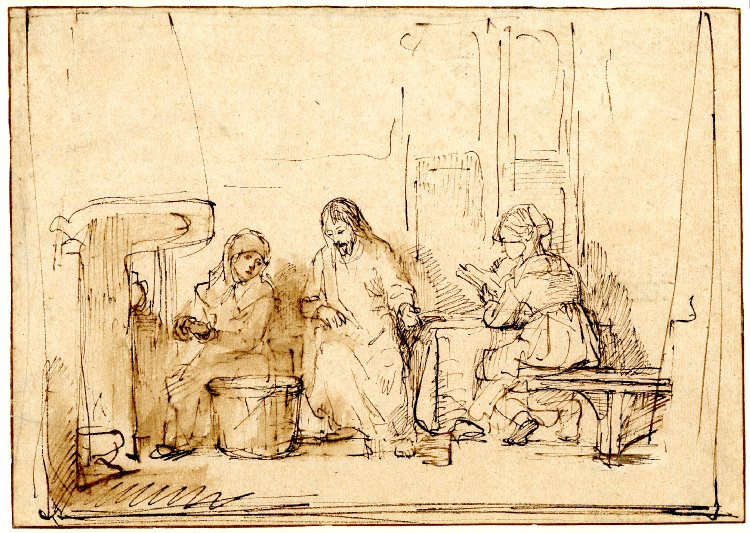
That’s a long and not particularly subtle introduction to this morning’s Gospel lesson, in which we see just such a dynamic at work. This is such a charming account, because the circumstances are so immediately recognizable to us, because we know Martha’s frustration so well, as she slaves away to honor her important and much-beloved guest with all the gracious customs of Mid-Eastern hospitality: Lord, do you not care that my sister has left me by myself to do all the serving? Tell her to help me. But her frustration earns a gentle rebuke from our Lord, and I think we are right to hear a hint of amusement in his tone: Martha, Martha, you are anxious and worried about many things. There is need of only one thing. Mary has chosen the better part and it will not be taken from her.

What matters is communion, time together. Well, Martha’s sin is small. It sprung from a good impulse. She was trying to do something good, something beautiful for Jesus, but in her eagerness she ended up getting things confused, she let the customs of hospitality get in the way of the goal of hospitality, serving got in the way of communion; she confused what was essential with what was merely important.

Well, again, it’s a charming story because it so personally familiar to us. We’ve been there. And not just on the purely human level of negotiating our own housekeeping needs, but also in terms of fellowship with our Lord. Here is our Lord – waiting for us in prayer, waiting for us in holy Scripture, present among us in the Blessed Sacrament; and here are we – running errands, driving carpools, meeting our responsibilities, checking Facebook.

In some respects it’s a very American, very modern problem, isn’t it? In our place and in our time, we are driven to be productive; we want something to show for our time, something measurable – money earned, a problem solved, meals served; at the very least a Facebook status updated! It’s difficult for us to be still at all, but perhaps most especially to be still and silent before our Lord, to put ourselves in his blessed Presence. So many young people I talk to tell me that they do their praying while they’re exercising – which is fine, it’s good to pray, that’s largely the point this morning – but still I have to wonder about this inability to be, or at least the choice not to be, still for just a little while, and at the end have nothing of this world to show for it, this incessant pressure to multitask even our prayer life.

But in our better moments, when we are most truly ourselves, we know better, and we do better. Lovers know better, young or old, they just need to be together, they can talk or not talk, and that togetherness, that communion, serves no other discernible end; it is self-justifying. One of my favorite songwriters, Ron Sexsmith, has song, a love song, that touches on this theme. He sings,

Don’t have the run when the pistol’s fired,
It’s alright if we let the meter expire.
Where’s the crime in wasting time with you?

Where’s the crime in wasting time? Lovers know better, and children know better, too. We parents plan activities and lessons and play dates, but our children don’t care about the “what” so much as the “who.” They want to be with Mama and Dada. They want presence; they want communion.

Lovers and children know better, but here we are – the Church, the very Bride of Christ. And here we are – by adoption and grace the Children of God. And so often, as with Martha, something gets in the way, and we miss him.

Our ingrained activism, this drive to be productive, is one thing that keeps us from communion, but it may that our activism sometimes serves as a mask for a deeper problem. We are talking about time with our Lord, an attitude of docility and receptivity and joy in his Presence. There is no greater privilege; there should be no greater joy! We can think of Adam and Eve, rejoicing in their Creator’s fellowship when he walked in the garden in the cool of the day. But then things changed. They sinned, rebelled, and when God came, they hid.

Out here, east of Eden, his Presence can be uncomfortable, can’t it? Our Lord still comes among us, but Jesus is a man to be reckoned with. In his light, we see ourselves more clearly, and perhaps we’d rather just dim the light, make like Adam and Eve and hide ourselves in the bushes of our activity. There are things we’d prefer to keep in the dark. So activism, just the general frenetic running to and fro of our daily lives in the world, or even – maybe especially – the busy-ness of good works and service – becomes a kind of cover, a strategy of avoidance of the very One that, like Martha, we are meant to be serving.

But that light that shines so brightly is the light of his love – his seeking, desiring, healing love. You know, earlier this week when I read over the lessons for this morning, it occurred to me that I have always thought of the tragedy of this encounter as being that in her busy-ness, in her inability to let the merely important things slide in order to not lose the essential, Martha robbed herself of time with Jesus. And that’s true enough and tragic enough, but it works the other way, too. In her busy-ness, she robbed her Lord – he wanted to be with her, desired her fellowship and presence, to be with her, just as he did with Mary and Lazarus and Simon the Leper and all the usual crowd at the house in Bethany.

And, in the same way, hard as it is sometimes to believe, he desires us. He’s dying to be with us. In the silence of prayer, on the Altar where he gives himself to us Body, Blood, Soul, and Divinity. He holds nothing back. And as for those things we are ashamed of, that keep us on some trajectory of avoidance – well, he already knows, and still he loves, and calls us to the confessional for honesty, reconciliation, healing, and ever deeper Communion.

And Presence. The Lord among us. It is not wasted time. It is life. It – He – is the one thing needful; He himself is the better part that will not be taken away. So come, let us adore him.

+ + +

Local Paper: Fr. Allen’s Journey

A profile of Fr. Patrick Allen from the Charleston Post & Courier:

It was barely a week into Father Patrick Allen’s new ministry when, in the course of taking his two children to activities in his nonreligious clothes, at least five people asked:

So, what do you do for a living?

Allen smiles graciously, sometimes bringing his hand to his chest in a humble gesture, one that coincidentally shows his wedding band.

“This might begin a long conversation,” the James Island father says.

“I’m a Catholic priest.”

When his daughter, Lucy, goes to Charleston Catholic School next year, she will be the only student whose father comes not only for parent conferences and class parties, but also to celebrate Mass.

Ordained a Catholic priest July 7, Allen joins a small but growing group of former Episcopalians embarking on a new journey, one they hope marks a critical step down the long path to Christian unity.

They have embraced a new option in Catholicism that allows Anglicans to become fully Roman Catholic yet retain elements of their liturgical and theological traditions.

Allen is the second Episcopal priest in South Carolina to join the Personal Ordinariate of the Chair of St. Peter, often dubbed the “Anglican ordinariate.”

Pope Benedict XVI created the ordinariate, a non-geographic diocese within the Catholic Church, for groups of American Anglicans who wanted to enter full communion with the Vatican.

The result: Two weeks ago, Allen lay prostrate before the Most Rev. Robert Guglielmone, bishop of Charleston.

Those on hand for his ordination included his closest Anglican mentor and friend, the priest who heads the ordinariate and the once-Episcopalian families joining him to create a new Catholic community…

Read it all!

Homily: 15th Sunday in Ordinary Time (C)

15th Sunday (C)
Lk 10.25-37
St. Mary’s
Fr. Patrick Allen

NGW184222In this morning’s Gospel lesson, we come to what is, with the possible exception of the Parable of the Prodigal Son, the most well-known of our Lord’s parables: “the Good Samaritan.” But before looking at the details of the parable itself, it’s helpful, I think, to remember the occasion, the question, that gives rise to the parable.

Jesus, we read, is confronted by a scholar of the law – that is, an expert in the Torah, the law of Moses, who wants to test Jesus. So this is not an honest question seeking insight, but an attempt by an expert to expose the ignorance of this self-taught rabbi – from Nazareth, of all places – as a charlatan and a rube. He wants to discredit Jesus, and he’s going to do it by provoking a little debate.

So, What must I do to inherit eternal life?, the scholar asks. Jesus knows how the game is played and replies with a bit of pleasing deference, asking his own question in return – “You’re the expert in the law – how do you read it?

And, let us give credit where credit is due, the scholar’s study has paid off. He gets the answer exactly right; it’s the very same answer, taken directly from the Hebrew Scriptures, that elsewhere in the Gospels we find on Jesus’ own lips: You shall love the Lord, your God, with all your heart, with all your being, with all your strength, and with all your mind, and your neighbor as yourself” (see Mt 22.37-39).

Now, this is where things turn a little weird for our scholar friend. Jesus is supposed to say something that begins along the lines of, “Yes, but…” Now they are supposed to begin a learned (at least on the scholar’s side) debate about the appropriate qualifications and distinctions to be made regarding the obviously exaggerated command to love God and our neighbor.

But that’s not what happens! Jesus want play. Instead he offers not the slightest caveat, not an ounce of nuance, only bare, 100% affirmation: You have answered correctly; do this and you will live – there’s nothing more to say.

And now it is not Jesus, but the scholar of the law – and each and every one of us who is exposed. Because if that’s the just standard, if perfect and pure love of God and neighbor are the keys to eternal life – and Jesus insists that they are – then the scholar knows he is condemned, and again – let us be honest; after all we’ve just admitted to God and one another in the confiteor – we, left to ourselves, are condemned with him, because we have failed at love, in things done and things we have failed to do, through our own faults, through our own most grievous faults.

In response to that kind of exposure, there are only a couple strategies. One is the way of faith, of course – we can lie down and die in faith and baptism, fleeing to God’s grace and mercy in penitence. But another is to try to shrink the requirement, to define the terms, parse the language, invent exceptions and excuses in such a way as to make the command small – or smaller anyway, to make it manageable, so we can justify ourselves and escape with our pride in tact.

This is the escape our friend the scholar opts for. And who is my neighbor?, he asks. Whom must I love as myself. And implied within the question is the other side – and to whom is my love not owed; whom may I safely ignore, pass by, from whose need may I safely avert my eyes? What are the legitimate limits of love?

That’s the question that draws the parable out of Jesus, that is the strategy of self-justification the parable of the Good Samaritan addresses.

Again, we know the parable, and we needn’t belabor the details. On the famously dangerous road between Jerusalem and Jericho, a traveler is set upon by bandits, severely beaten, robbed, stripped of even his clothes, and left for dead. Now come the passers by: first a priest, and then a Levite. Religious people, and professionally so, the very representatives of God’s law and worship, and they see the man, naked and bleeding, half-dead at least, and they shift uncomfortably to the other side of the road – into the other lane, just as I so often do down at the corner of Spring and Lockwood, where there is always the homeless man with the cardboard sign – they shift to the other lane, and they keep moving.

Now, it’s likely that the people listening to Jesus tell this story shared some smirks at this point. The madding crowd then, just as now, loved to see the mighty brought low, and loved especially the exposure of hypocrisy among the publicly and professionally religious – even if it’s not really a matter of hypocrisy at all but just garden-variety human weakness.

But perhaps we shouldn’t be quite so hard on these two passers by. After all, they had places to go and people to see, jobs to do and religious duties to perform. Maybe this is less hypocrisy and fear than what is sometimes called “an abundance of caution.” After all, the Mosaic law stipulated that anyone who touched a dead body would be ceremonially unclean for seven days (see Nm 19.11-13). That’s a week’s stay-at-home unpaid furlough. And we read that the victim was left “half dead,” perhaps unconscious, and how do you tell whether a man is dead or just half dead, except by touching him? What would have happened had they stopped? There likely would have been consequences, consequences borne not just by themselves but by their family and other dependents as well.

So it may be that Jesus isn’t just serving up some stock characters, the usual hypocritical suspects, to get the crowd on his side, but rather is pointing them and us to the hard choices that love in a fallen world often requires. Love always costs, and our Lord wants us to count the cost.

Well, if the crowd smirked at the priest and the Levite, they would have been scandalized at the third passer by, the hero of the story, the Samaritan, who does stop, who pours on oil and wine, binds up wounds, and carries the poor beaten man to an inn and pays for his continued care. Generally hated by the Jews of Jesus’ day (and the feeling was generally mutual), the Samaritans were considered to be ill-bred, racially inferior heretics. By introducing a Samaritan hero, an outsider, Jesus is stirring up, exposing to his kindly light, the religious, racial, and historical prejudice of the crowd. None would have considered that they owed neighbor-love to a Samaritan – just the opposite. But it is the Samaritan who stops, the Samaritan who loves.

The scholar of the law wanted to define terms, to parse language, and to shrink the circle of neighbors. Well, it turns out that Jesus is interested in defining terms as well. And it’s not just that he pushes the love-thy-neighbor command beyond the normal and expected borders of proximity: family or tribe or race – “folks like us”. As so often, he turns the whole matter on its head: Which one of these three…was neighbor to the robber’s victim?, he asks. He’s not interested in “neighbor” as object, but “neighbor” as subject. In other words, for Jesus, the question to ask is not “who should or should not be the object of my love, of my mercy” – but rather, am I a lover? Am I merciful? And here there can be no divorce between being and doing. Mercy is as mercy does. In Jesus’ terms, it’s not possible to define one’s neighbor, one can only be a neighbor.

Go and do likewise, Jesus says. The question Jesus would have us ask is not the scholar’s Whod is my neighbor?, but, “Am I a neighbor? Are we neighbors?” And then we have to ask ourselves, if I find that I don not have a neighbor’s heart, what do I do? How can I exchange this heart of stone for a heart of flesh?

Well, we’ve talked about the priest, and about the Levite, and about the Samaritan. But of course there’s one more character in the story. There’s the half-dead man in the ditch. Who is he? Is he a Jew or Samaritan? Rich or poor? Righteous or sinner? In he one of the “deserving poor” or not? There’s no way to tell. But when we place the parable back into the context of the Gospel – don’t we begin to recognize him? Doesn’t that profile begin to look familiar? A man for every man, outside the city, beaten, bleeding, naked, dying, with…

…No form or comeliness that we should look at him, and no beauty that we should desire him. He was despised and rejected by men; a man of sorrows, and acquainted with grief; and as one from whom men hide their faces he was despised, and we esteemed him not… But he was wounded for our transgressions, he was bruised for our iniquities; upon him was the chastisement that made us whole, and with his stripes we are healed (Is 53).

Blessed Mother Theresa was once asked by a journalist what had led her and her sisters to Calcutta to do “social work” among the poorest of the poor, picking up the discarded and dying out of the gutters. And she quickly replied, We are not here to do social work. We are here to adore Christ in the least of his brethren. On another occasion she was visited by another journalist, and as she washed the failing body of one more discarded human being, with tweezers carefully pulling maggots out of the man’s festering sores, the journalist was overcome by the stench and horror and said, “Mother, I wouldn’t do what you do for a million dollars.” She looked up at him with that wizened face, smiled, and said, “Neither would I.”

I wouldn’t be a neighbor for a million dollars. Mercy can be hard, and inconvenient. It often requires difficult choices. Love costs. But recognizing the face of the half-dead man in every one in need, to see and taste his love for us in his broken body and poured out blood, knowing that those stripes and wounds are for me, for us, will make all the difference. It will raise us to new life, and turn us in to neighbors.

Fr. Allen’s Ordination

ordinationFrom the Catholic Miscellany:

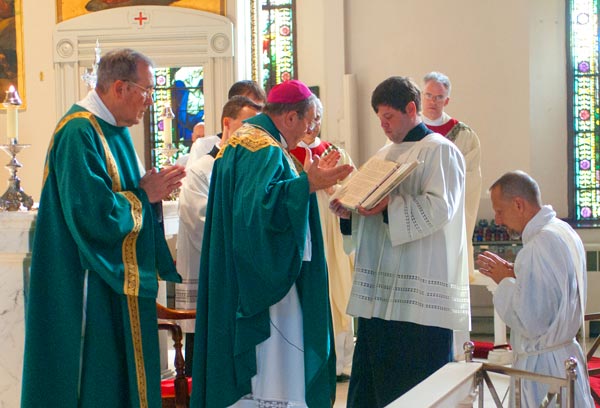
CHARLESTON—Episcopalians and Catholics united in support of Father Patrick Allen as he was ordained for the Personal Ordinariate of the Chair of St. Peter on July 7.

Bishop Robert E. Guglielmone ordained Father Allen, a former Episcopal priest, at St. Mary Church in front of about 80 people.

At the beginning of Mass, Father Allen sat next to his wife Ashley. Their children — Lucy, 4, and Henry, 2 — did not attend but waited for them in the reception hall.

Father Allen is the second Anglican priest to enter the ordinariate in South Carolina. The first was Father Jon Chalmers, who was ordained last summer. Father Allen’s community is comprised of six families who joined the Catholic Church in June…

Read more: http://www.themiscellany.org/index.php/news/4534-second-priest-ordained-to-anglican-ordinariate-in-south-carolina#ixzz2Yw48LsuV