And click here to go to the first video in this series.
Month: January 2014
Sunday, January 19: A Visit from the Ordinary!
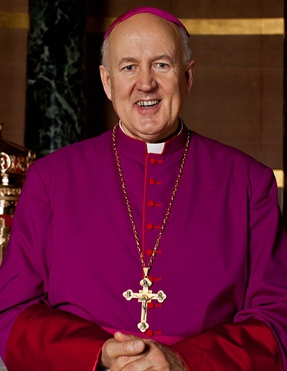
We are glad to welcome our Ordinary, Monsignor Jeffrey Steenson to Corpus Christi on Sunday, 19 January. Monsignor Steenson will celebrate and preach at our 11.30 Mass, and join us for a luncheon in the St. Mary’s parish Hall immediately after Mass.
This will be a great time to learn more about the Ordinariate and experience the Anglican Patrimony in the Catholic Church – all are invited and welcome!
Homily – The Baptism of the Lord
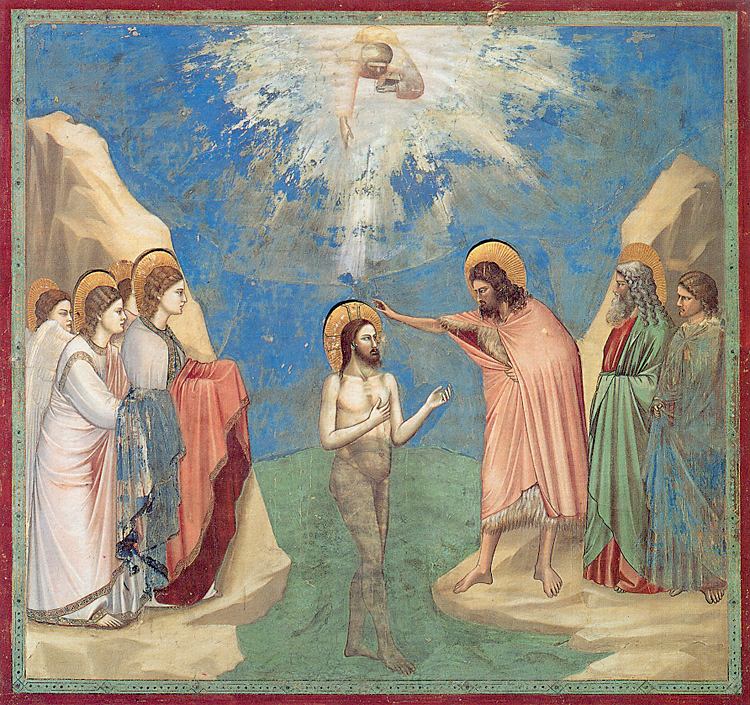 The Baptism of the Lord
Is 42.1-4,6-7; Mt 3.13-17
12 January 2014
Fr. Patrick Allen
+ + +
Not too long ago I was compelled to appear in traffic court, and I have to say that what I anticipated to be something of an ordeal turned out to be quite enjoyable. It certainly helped that my sins – excuse me, my alleged sins – were wiped away with a bang of Judge Mendelsohn’s gavel (such a very fine man, Judge Mendelsohn), but also it was enjoyable because I saw so many old friends there. But in the midst of all the joyous reunions, I did get a good bit of “Father, what are you doing here?” Though I suppose there were also some who were relieved to see a priest in court for a mere traffic offense – I mean, alleged traffic offense.
“What are you doing here?” might serve as a rough paraphrase of St. John the Baptist’s words to our Lord when he appeared on the banks of the river Jordan seeking baptism. John would have prevented him, we read, saying, I need to be baptized by you, and do you come to me? “What are you doing here, Jesus?”
Immediately before the paragraph with which this morning’s Gospel lesson begins, John had just finished saying to the crowds, I baptize you with water for repentance, but he who is coming after me is mightier than I, whose sandals I am not worthy to carry… And yet here is Jesus, whom John knows to be the Messiah of God, sent to rescue God’s people. Here is Jesus, whom we know to be without sin, seeking a baptism that is specifically a sign of repentance from sin, of turning away from sin, of an internal conversion marked by outward conformity to the law of love. Yet Jesus is the manifestation, the very incarnation, of Love. So, what in the world is Jesus doing here?
To answer that, we might begin with a wonderful story the theologian Scott Hahn relates about Blessed – soon to be Saint – John Paul II. An American priest was visiting Rome and was invited to a private audience with the Pope. On the day of the audience, the priest decided to walk from his residence to the Vatican, and on the way he stopped in to a church to pray. There were a number of homeless men congregated on the steps of the church, and as the priest entered, one face in particular caught his eye and seemed strangely familiar to him.
After saying his prayers, the priest saw the man again on the way out and approached him saying, “Excuse me, but do I know you?” And the homeless man said, “Yes, Father – we were at the seminary together.” They had been seminary classmates, but some time after their ordinations, the homeless man had fallen into alcoholism and a crisis of faith and then despair, and had abandoned his ministry, eventually ending up on the streets.
The priest left for his audience, and told John Paul about his encounter with the beggar. John Paul told him to return that evening for dinner, but first to find the man and bring him along. Well, the priest found the man, still on the church steps, and took him home to get showered and changed into clean clothes, and then off they went to supper with the Pope.
Towards the end of the meal, John Paul asked the priest and the others there to leave so he could talk with the homeless man. After some time, the man emerged, eyes red from weeping. “Did he ask to hear your confession?” the priest asked his old classmate. “No,” said the homeless man, “he asked me to hear his. I told him, ‘Your Holiness, I am just a beggar.’ And he said, ‘So am I.’”
“So am I.” It’s a wonderful story of John Paul’s humility, but also of his honesty. He knew himself to be a sinner and in absolute need of God’s grace, and so he understood there was no essential difference between himself and the beggar-priest. “So am I.”
If we are moved, as we should be, by John Paul’s humility, by his gracious condescension, then we are ready for the next step in thinking about our Lord’s baptism. But the next step’s a doozy. Our Lord, submitting to John’s baptism, for us and our salvation, takes an infinitely greater step of humility and love. Though sinless, though perfect as his Father in Heaven is perfect, he condescends to share our lot, to stand shoulder to shoulder with us, and identify himself with us. Jesus entering the Jordan is a sign of his absolute solidarity with all of us who, as St. Paul says, “have sinned and fallen short of the glory of God.” That is what our Lord is doing here on the banks of the Jordan.
As one theologian put it, in this baptism, “he associates himself with sinners and ranges himself in the ranks of the guilty … because he is at one with the church and the bearer of the divine mercy” (A. Schlatter).
It’s a wonderful thing to know that in the sacrament of reconciliation, when we approach the confessional, Jesus our merciful judge is waiting there, eager to forgive us every trespass and raise us up to new life. But this feast of the Lord’s baptism tells us something else wonderful: that as we approach the confessional, he also stands in line with us, shoulder to shoulder with us – whom he loves, and for whom he offered himself up to the Father. We may be, rightly, ashamed of our sins, but our Lord is not ashamed of us. He stands with us, placing a gentle arm around our shoulders: a bruised reed he will not break, and a dimly burning wick he will not quench.
And notice that it is here, precisely as Jesus takes this definitive step of identification with sinners, in this act of self-emptying love, that God is manifested in his Trinitarian glory: God the Son emerges from the waters; God the Spirit descends as a dove; and God the Father speaks – this is my beloved Son, with whom I am well-pleased. “Where true love is, there is God.”
Blessed John Paul II had experienced and known that love, and so he could be honest about himself, humble himself, and then greet a fallen priest with love and mercy. He could admit his fundamental solidarity with a fallen priest. The courage and honesty, that mercy and love, that solidarity, is derivative from, is a product of, our Lord’s self-emptying solidarity with us, manifested in his baptism. It is the same Love into which we are plunged, to whom we are united, in baptism.
Blessed John Paul understood it. God grant that we may understand it, too, and like him become loving and merciful, and with him become saints.
John Paul, pray for us!
+ + +
Homily – The Holy Family of Jesus, Mary, and Joseph
The Holy Family
Mt 1.18-24
29 December 2013
Fr. Patrick S. Allen
Corpus Christi
+ + +
On Christmas Eve at the Midnight Mass we heard from St. Luke’s Gospel that when the shepherds heard the angel’s announcement they went to Bethlehem “with haste, and found Mary and Joseph, and the babe lying in a manger.”
Last week the Catholic writer Elizabeth Scalia published a short, fictional description of what that encounter must have been like for the shepherds when they found the Holy Family (“A Shepherd I’ll Remain”). Here is here imagining of that moment of encounter:
All is as we have been told. As we approach I see tears coursing down my father’s weathered face, and he does nothing to stanch them. My uncle stands in muted awe, lamb still across his shoulders, and my cousin steps eagerly forward and is stayed by a man. He is older than our own fathers and his countenance is careworn, kindly—radiant, within that luminescence. We tell him what we have seen—that we have been invited—and he tells us his name, Joseph, and permits us to linger at the edge and peer within. We behold a young mother cuddling a newborn. Having fed him of herself, she is in the act of placing him on the freshly-lain, sweet-smelling straw with which the manger has been filled. After a glance at Joseph, she raises the babe, that we might better see him. She holds him high against her breast, showing off her son with obvious pride and love, and with her right hand she makes a gesture of presentment. We are confounded to adore him with an ardor strangely equal to her own. Finally, she lays the child down. In the food bin, he rests.
These first witnesses, these first worshipers, beheld Jesus in the context of a family – a mother, a father, and a newborn son. That is why in the Church’s yearly pattern of devotion on this, the first Sunday after Christmas, we keep this great feast of the Holy Family of Jesus, Mary, and Joseph. And of course in a week’s time we will keep the feast of the Epiphany when our Lord was manifested to the Gentiles in the mysterious persons of the Magi, who, again, discover “the King of the Jews” whose star they had seen in the East precisely in the context of a family. The family – the normal, human family – is the context in which Jesus is known and must be understood. And so on this day we are invited to contemplate this image, this icon, of the Holy Family in which the little little Lord Jesus “appears as the center of his parents’ affection and care” (http://www.vatican.va/holy_father/benedict_xvi/angelus/2010/documents/hf_ben-xvi_ang_20101226_santa-famiglia_en.html.
It’s in this context that we understand that Jesus shared our full humanity, that he really one of us, one with us – not only in the strictly biological sense (important as that is), but in the normal social, developmental, and experiential senses as well. He grew and matured in the virtues of faith and love just as any child, any many man, ordinarily does – if he does – that is, from his parents. From them Jesus came “to know the beauty of faith, of love for god and his law… the demands of justice, which are fulfilled in love.”
And it is in this context, the context of our own families, of course, that we come to know him. We have in our Old Testament and Epistle readings today meditation on and instruction in family life. Sirach speaks to us of the honor children ought to bear toward parents, especially in their old age. St. Paul speaks of the gentleness, respect, and loving obedience that ought to obtain within the family. But, as Pope Benedict once pointed out, the Gospels really contain no discourses, no significant instruction from our Lord, on family life. However, our Pope Emeritus pointed out, they contain “an event which is worth far more than any words: God wanted to be born and grow up in a human family. In this way he consecrated the family as the first and ordinary means of his encounter with humanity” (http://opeast.org/2013/12/24/preachers-sketchbook-feast-of-the-holy-family-of-jesus-mary-and-joseph/).
“The first and ordinary means of his encounter with humanity.” Children will see, or not see, something of God’s tender love in the way they are cared for by their parents. They will learn the laws and precepts of the Church not so much by, or not so deeply by, explicit lessons as by the example of their parents’ faithful and joyful observance.
I don’t think I need here to belabor the point of how important the family is – but precisely because the family is so important, so foundational for the raising of children in the nurture and admonition of the Lord, it is therefore all the more important that we do not let it become an idol. The family is a beautiful means to an even more wonderful end – a saving encounter with the Lord Jesus – it is not an end in itself.
Because family is hard. It is difficult to maintain a marriage, to raise children as Christians in a culture that is seemingly everyday more hostile to and corrosive of the virtues and priorities of faith. And when we allow family to become an idol, well, it just can’t bear the weight. Children will disappoint, spouses will stumble, parents will fail. I won’t even mention the scourge of siblings! And if a shiny happy family is our ultimate end, our goal, our idol, then we won’t know what to do when the problems come, as they must.
So you see, the family is a school for the virtues of Christian faith because the family so desperately needs the virtues of Christian faith.
Blessed John Paul II put it this way: “The Church is deeply convinced that only by acceptance of the Gospel are the hopes that man legitimately places in marriage and in the family capable of being fulfilled” (http://opeast.org/2013/12/24/preachers-sketchbook-feast-of-the-holy-family-of-jesus-mary-and-joseph/). And to “accept the Gospel” is to accept, and to embrace, and to cling to the truth that God in Christ has done for us what we cannot do for ourselves; that Christ is our righteousness; that we are the objects of God’s love and mercy and patience and forgiveness. And having accepted the Gospel, the family is, again, “the first and ordinary” context in which we learn to extend that same love, mercy, patience, and forgiveness. Which is to say, that it is the first and ordinary means, the first and ordinary location, of our daily conversion to Christ, so that the image and likeness of God, our true humanity, is restored in us.
In the Holy Family, in the Babe at its heart, we see that perfect image and likeness. That family was not aloof from the trials of normal family life. Right from the beginning, like any parents, and each in her and his own way, Mary and Joseph had to make the decision to receive this child as a gift given and intended by God, with all the life-altering burdens that would normally entail, and the special burdens this particular child would entail. Joseph in the dead of night leading his wife and child away from home and kin to Egypt, as we have read in this morning’s Gospel. There was the sword that would pierce Mary’s own heart as she kept her station at her son and Lord’s cross. But by their faithfulness, by the burdens they would carry, by the love they gave one another, this babe would grow, as St. Luke tells us, “in wisdom and in stature and in favor with God and man,” so that, when his hour came, he would fully and perfectly offer himself up to his Father in heaven, and our salvation would be accomplished. That’s what a family can be and do.
Jesus, Mary, and Joseph, save souls! And renew the Christian family!
+ + +
Homily – Christmas Eve 2013
Christmas Eve
A.D. 2013
Fr. Patrick S. Allen
Corpus Christi Catholic Community
+ + +
I proclaim to you good news of great joy that will be for all the people.
For today in the city of David a savior has been born for you who is Christ and Lord.
The message the angel proclaimed to the shepherds so many centuries ago is still the message the Church proclaims, the truth to which it bears witness. A savior has come – and what a savior. I don’t get to the movies much, but I know something about the action-adventure genre, and so I know what a savior looks like and what he does. Slabs of muscle, a week’s growth of beard, an automatic rifle, and things blow up. Violence and destruction – that’s the way the rescue happens.
It’s easy to make fun of the endlessly repeated conventions of Hollywood movies, but those movies sell, they keep making them, because they speak to something in us – they appeal to a primal sense within us, a sense of what vindication and rescue – salvation – require.
It’s an old story, much older than Hollywood. So in the sacred Scriptures we read of Elijah, fleeing from wicked Jezebel, hides in the cleft of the rock and waits for the Lord to show up and the vindication to begin – and “a great and strong wind rent the mountains, and broke in pieces the rocks before the Lord, but the Lord was not in the wind; and after the wind an earthquake, but the Lord was not in the earthquake; and after the earthquake a fire, but the Lord was not in the fire.” And then – do you remember? – a still, small voice, and it was the Lord. “What are you doing here, Elijah?” he asks.
And now, in this newborn child, wrapped in swaddling clothes and lying in a manger, that still, small voice, that Word, is made flesh. And, in a sense, in his own gurgling, squirming way, he asks, “What are you doing here?”
What are you doing here? Do you have some issues you want to thresh out? Babies can’t be argued with – I’ve tried. Is there some great end you want to see accomplished? Well, it’s no good enlisting babies in a cause. Are you here for a sweet, sentimental experience, “just like the ones you used to know” – cozy with family and nostalgia and the old carols? Well, we have all that, and I’m glad to have them – but of course, if that’s what you’re after, you’ll have to leave the baby out. Because this isn’t a celebration of some kind of abstract “baby-dom” – this child, “conceived of the Holy Spirit and born of the Blessed Virgin Mary” is a real, particular baby, who will need his Mother’s care, need to be fed, need to be changed. This is a baby born on the dirt and dung floor of a barn, now cradled in a feeding trough, because no one would give up a bed to a laboring mother.
And this is our Savior. This is our God. Power and majesty are laid by. Instead he comes in simplicity. He comes still and small. He will not reign by overwhelming force, because our salvation is to love him, and loving him to share in his life, because he is Love. And so he comes as a child.
Of course there are issues and arguments that we need to work through. And there are great and noble causes that call forth our commitment and best efforts. And there is, in every human heart, an aching nostalgia, a yearning for our true home. But the answer to the questions, the path to victory, the road home, all begin here, at the manger, with the Word spoken by and in the Baby. They begin with God, “for us men and for our salvation,” making himself small, emptying himself for us, giving himself to us, loving us.
In fact, saving us. Hollywood has its endlessly recycled story of salvation achieved by violence and destruction, and its an old story – no doubt Cain told it to himself as he slew his brother Abel. But the Christmas story is unique and ever new. The strong makes himself weak. God becomes a baby, and speaks to us, saves us, in the still, small voice of a baby’s coo. And the Word he speaks is life and joy and salvation, because the word he speaks, the Word he is, is Love.
So then, what are you doing here? Come, friends, let us adore him. Merry Christmas!
+ + +
Corpus Christi News, 1/11/14 – Visit from the Ordinary!
Hello, friends –
 Great news! I heard yesterday from our Ordinary, Monsignor Jeffrey Steenson, that in the course of his travels he is able to come to Charleston next weekend and be with us for Mass next Sunday (1/19). He will celebrate and preach (I know I’m ready to hear someone who is not me, so I’m sure you are), and we will have lunch afterward in the parish hall (Judi Lester has again consented to coordinate). So be sure to be with us – and this would be an excellent Sunday to invite a friend or six to come and see what we and the Ordinariate are all about. More details to come!
I also am glad to share the news that our friends and fellow travelers Seth & Tyler Whitaker welcomed their first child, Lucy Elizabeth, on January 2nd, soon to be baptized according to the Ordinariate rite. Congratulations and blessings!
This Sunday, the first Sunday after the Epiphany, is the solemnity of the Baptism of the Lord – come to Mass and give praise to the Lord who, though sinless, for us men our salvation condescends to stand shoulder to shoulder with sinners!
Finally, actual printed-on-dead-trees thank you notes are forthcoming, but thanks to all of you for your generosity to me and my family, and to Corpus Christi, at Christmas time.
God bless you,
Fr. Allen
 Corpus Christi Catholic Community