Sermon: the 19th Sunday after Trinity (10/26)

19th Trinity (OT 30a)
Mt 22.34-40
26 October 2014
Fr. Patrick AllenRembrandt_221
+ + +

As I understand it – which is hardly at all – contemporary physics is on a quest for what is sometimes called a “Theory of Everything” – that’s an arresting phrase, isn’t it? Modern physics operates under two theories, or frameworks. The theory of General Relativity focuses on gravity and explains large-scale, high mass phenomena – stars, galaxies, and so on. And it works; it has enormous predictive value. On the other hand, when it comes to understanding and explaining very small-scale, low-mass phenomena – atoms, subatomic particles, and so on – physics relies on what is known as Quantum Field Theory. And it works; it also has enormous predictive value. The problem is that when it comes to some phenomena, at least on the theoretical level, the two theories actually conflict with one another; they can’t both be true. And thus a search for the Theory of Everything, “the deeper underlying truth that can harmoniously integrate both General Relativity and Quantum Field Theory – a single theory that is, in principle, capable of explaining all phenomena” – I copied that straight out of Wikipedia, so it must be true!

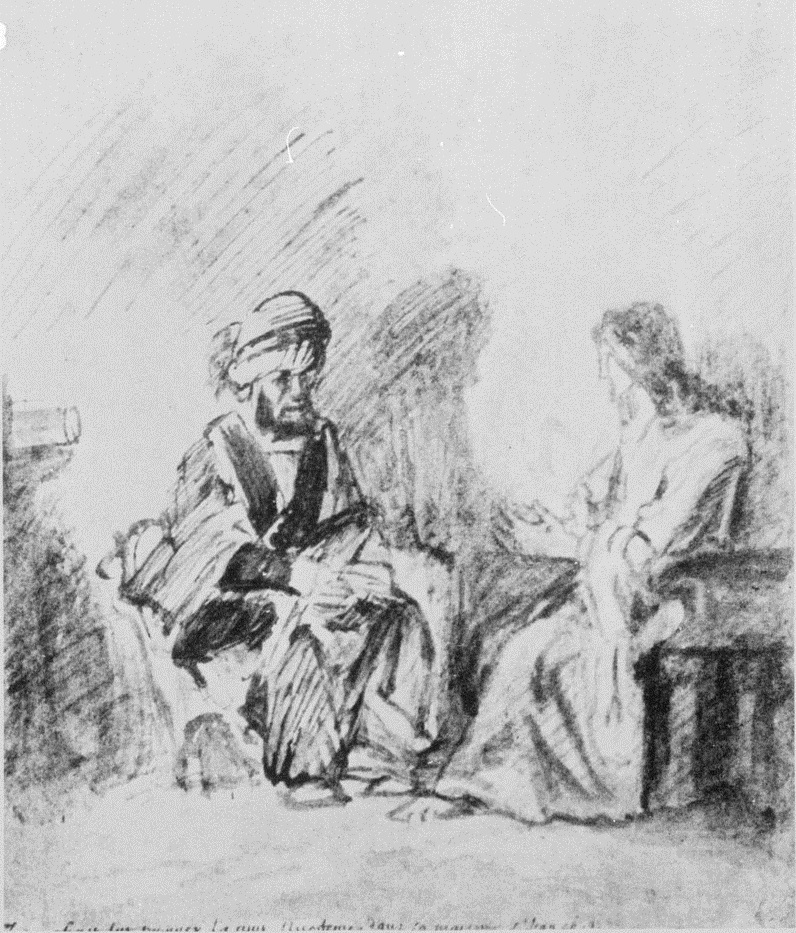
In this morning’s Gospel, we see the Pharisees, in particular one lawyer on an analogous quest: Teacher, what is the greatest commandment in the law? St. Matthew tells us that this was a test – and in fact this was a much discussed and debated question among the rabbis; it manifested a particular concern, a kind of angst within the ancient Jewish tradition, to find “a unifying principle in all the various formulations of God’s will” (Benedict XVI, 2008) – a single commandment, if you will, capable of explaining all the prohibitions, principles, and precepts to be found within the Torah. And this was a difficult question, a real test: the rabbis discerned 613 distinct commands within the Scripture, and what made sense of, gave a meaningful interpretive context to, all of them? Were they 613 essentially arbitrary commandments, or could there be discerned, could Jesus discern, a central, unifying principle, a “theory of everything.” What is the greatest commandment in the law?

And this is not merely an academic question; it’s important, and not just for what it tells about the law, but because of what it tells us about the Law Giver.

Jesus has his answer, he doesn’t hesitate. He quotes immediately from Deuteronomy: Thou shalt love the Lord thy God with all thy heart, with all thy soul, and with all thy mind; this is the first and greatest commandment. And then he goes for the extra credit, quoting now from the Holiness Code in Leviticus: And the second is like unto it, thou shalt love thy neighbor as thyself.

Love is the answer. Well, of course it is. “All you need is love, yeah, yeah, yeah,” etc., etc., etc. Love is the answer – but is it, really? Or, maybe I should say, does knowing that, hearing it from Jesus really help? We might even ask if Jesus is actually making sense.

Thou shalt love, he says. Well, I don’t know. Love can be encouraged, enjoined, recommended; it can, I suppose, be advised. But can love be commanded, demanded, required – a matter of law? And not only a just demand of the law, but the very lynchpin and ground of all God’s legislation – this double law from which all the law and the prophets are derived and find their meaning.

Can love be commanded? It’s a real problem. And by “commanded,” and by “problem,” I don’t mean “coerced.” Love is free by definition. And to whatever degree some word or some deed is coerced or bargained for or extorted, whatever else it may be, it cannot be love.

But what I mean is, can love – complete and unstinting love – be justly commanded if it is not in our capacity to give it? What if we can’t do it – does God have the right to demand it?

You know another silly season of electoral politics is soon upon us, and we will hear and perhaps take part in debates about the appropriate rate of taxes on the profits of corporations and the income of individuals. Some think the top rate should be 10%, others will argue that it should be closer to 90%, but no one thinks it should be 101%, right? No one thinks it is just to demand more than a person has.

Can love be justly commanded if it is not in our capacity to give it?

There are, of course, some people whom it is very easy for me to love, the very sight of whom calls forth my love. And I may, after all, either because of a sense of guilt or genuine distress at another’s ill fortune be moved to some act of material charity. A few dollars for the homeless veteran, an hour of my time to visit someone old, sick, and alone. But to open my heart to another, to a stranger – or worse, someone I know and know to be difficult – and genuinely to desire his presence, his company, and his well-being, so that we come to share our lives together, which is is what this double commandment requires: that is a different matter altogether. Even if I see the justice in it, how can I will it to be so? How can I reach inside and remake my own heart?

In his Confessions, there is a section in which St. Augustine meditates on the virtue of continence, sexual self-mastery, and upon the goodness and difficulty thereof. And then, as ever, he turns his meditation to prayer: “O God,” Augustine prays, “on your great mercy rests all my hope. Lord, you command continence: give what you command, and command whatever you will.”

“Give what you command, and command whatever you will.” Augustine understood that if he were to live into the just and good requirements of the law, he would require, indeed he would depend every step of the way, on God’s grace and mercy; God would have to give what he commands.

Thou shalt love, Jesus, the new Moses commands, and we know it is right, that it is just and good. And our only response can be to pray with Augustine, “Yes, Lord, but give what you command, and then command whatever you will.”

And of course, that is just what Jesus does, just what he is doing, as he hands himself over to these “chief priests and elders of the people,” to be baited and tested by Sadducees and Pharisees and their lawyers, obedient to the law of love unto death, even death on a cross, a whole-hearted, whole-souled, whole-minded gift of love to the Father, by giving himself for his neighbor. “Having loved his own,” St. John says, “he loved them – even you and me – to the end.”

Thou shalt love, Jesus says. And it is precisely in him that the command is fulfilled. He has given, finally and fully, what he has commanded. And as we see that love, and yield ourselves to that love, and by our own stumbling steps of self-offering on behalf of our neighbors unite ourselves to and participate in that love, then we will be changed: hearts of stone will become hearts of flesh; we will look around and recognize strangers and enemies as, in truth, friends and neighbors, whose well-being, whose presence and companionship we long for. Indeed, all the commandment will make sense, and the heart of the Law-giver will shine through them.

And in the end, we will rejoice to find that Thou shalt love was never really a commandment at all, not at its deepest level, but a promise. Thou shalt love – and finally, purged of guilt and every stain of sin, we shall. We shall love, because he has loved us, and given what he commanded.

+ + +
“CATHOLICISM” Video Series: Journey to the Heart of the Faith

The_Catholicism_Series_Banner

In breathtaking, high-definition cinematography, the beauty, goodness and truth of the Catholic Faith are illustrated in a rich, multimedia experience.

Journey with acclaimed author, speaker and theologian Fr. Robert Barron to more than 50 locations throughout 15 countries. Be illuminated by the spiritual and artistic treasures of this global culture that claims more than one billion of the earth’s people.

From the sacred lands of Israel to the beating heart of Uganda… from the glorious shrines of Italy, France, and Spain, to the streets of Mexico, Kolkata, and New York City, the fullness of CATHOLICISM is revealed. Journey deep into the Faith as you watch each episode.

Join us for this compelling video series, with lively discussion!
Monday evenings, 6.30, beginning 10 November at the John Paul II Center,
Daughters of St. Paul Bookstore, 243 King Street, Charleston

Sermon: 18th Sunday after Trinity (OT 29-A)

18 Trinity (OT 29c)
Mt 22.15-21
19 October 2014
Fr. Patrick Allen

 + + +

“The enemy of my enemy is my friend” is an old saying of practical – even Machiavellian – politics.  And we see it on full display in this morning’s Gospel lesson: The Pharisees went and took counsel how to entangle Jesus in his talk; and they sent their disciples to him, along with the Herodians…”

Of course, normally, the Pharisees and the Herodians would have had nothing to do with each other – except perhaps to throw stones at one another.  The Pharisees were Jewish nationalists, who longed to throw off the yoke of Roman occupation. The Herodians were, as you might guess, supporters of Herod, who himself was backed by the Romans – “go along and get along” was their attitude. And yet, here they are together with a question for Jesus – although it’s not really a question at all, at least not an honest one.

Tell us, then, what you think, they ask. Is it lawful to pay taxes to Caesar or not?

Again, it’s not a question; it’s a trap. If Jesus answers that paying the tax is unlawful – that is, opposed to Torah – then Jesus will immediately be guilty of insurrection, of fomenting rebellion. Calvin Coolidge famously said that “the business of America is business,” and I sincerely believe he was wrong about that – the business of America is the liberty of persons and communities. But in a very real sense, the business of Rome really was business. The whole point of extending the empire into backwaters like Palestine was to collect taxes and send them back to Rome, and there was no toleration for anyone who called the system into question.

This was no new issue. In fact, when Jesus would have been a young boy, there was a revolt on precisely this issue, and the Romans had ruthlessly crushed it, leaving the countryside littered with crucified revolutionaries.

On the other hand, if Jesus answers that it is lawful to pay taxes to Caesar, he will alienate the people, who hated the Romans and found the tax offensive and a token of injustice and oppression. Indeed, all those crowds of people who supported Jesus, those who welcomed him with palm branches and shouts of “Hosanna! Blessed is he who comes in the name of the Lord!” when he entered Jerusalem just a few days before, supported him as a hoped-for political and military Messiah – and what’s the point of that if not to get rid of these hated Romans and their taxes.

So, how will Jesus answer? Notice, first of all, how he begins: he asks his questioners to produce the money for the tax. It’s worth noting that he himself doesn’t have one. And the fact that his questioners do reveals that they themselves are already blithely complicit in the Roman system.  The coin would have been the Roman denarius, with Caesar’s image stamped upon it, and the words “Caesar, Son of God, High Priest” engraved around the edge – all of which, from the commandment-violating “graven image” of a human being to the blasphemous inscription would have been deeply offensive to any devout Jew.

And so we may, I think, fairly imagine Jesus holding the coin slightly away from himself, much as someone might handle a dead rat, a maybe some foul bit of trash pick up while walking along the beach, now ready to ask his own question: Whose likeness and inscription is this?

Caesar’s, they reply. Then, says, Jesus, Render unto Caesar the things that are Caesar’s, and unto God the things that are God’s.

Render unto Caesar the things that are Caesar’s. Rather than falling into the trap that has been set, Jesus offers a new way to think about their money – namely, hard as it was, hard as it is, to believe, that money is not ultimate. There has been a movement in recent years towards an enforced secularization in American society – that is, from governmental neutrality among religions, or between religion and no religion, and towards a kind of official atheism in which all references to the divine and transcendent are scrubbed from public life. And so we have seen attempt to remove the phrase “under God” from the Pledge of Allegiance, but also the motto “In God we trust” from our money.  Now, in general, I think we ought to be concerned about that – although my concern there is more as an American than as a Christian.

But there is, let us admit, a certain and unavoidable irony in placing the motto “In God we trust” on our money, of all things, because we so deeply trust in money to fix what ails us. “Money don’t get everything, it true / But what it don’t get, I can’t use,” the Beatles sang.

Jesus, without saying anything about the justice or injustice of the tax or the Roman occupation, asks his opponents, and asks us as well, to consider just where their true allegiance, their faith, lay. Why he asks, are you so concerned, to the point of violent revolution or the compromise of your consciences, with this stuff? Have you made a means into an end? Have you made a secondary concern an ultimate?

Or, to put it another way, Jesus was essentially saying that political oppression and unfair taxation were not their biggest problems.

And so then he adds, and render unto God the things that are God’s. We see the connection. The coin belongs to Caesar and should be returned to him, because it bears his likeness. The word in St. Matthew’s Greek is eikon, and it is the same word used in the Greek language version on the Hebrew Bible when, in the Genesis creation account, God says, “Let us make man in our own image…”

You, your whole self, belong to God, Jesus is saying, and that is the issue you need to deal with. As an ancient commentator on this passage said, “The image of God is not impressed on gold, but on the human race. Caesar’s coin is gold, God’s coin is humanity…. Therefore give your riches to Caesar but keep for God the unique innocence of your conscience, where God is contemplated….”

God’s claim, Jesus is reminding us, is much more sweeping than Caesar’s. Caesar wants your money, but God wants your reason, your body, your sexuality, your time, your creativity, your thinking and your speaking, your waking and sleeping, your living and dying – every human capacity. Jesus is simply asking us to ask, “What am I, and what am I for?”

This analogy between Caesar and our Father in heaven, of course, quickly breaks down: Caesar is a taker, and God is a lover. God’s claim does not stunt or limit our human capacity, but places them in the context in which they can be properly used toward their true ends, and so flourish and grow: it is not arbitrary choice but conformity to the truth that actually sets us free.

God is a lover; “God is love.” It is here that we learn what it means at the most basic level to render… unto God the things that are God’s. God is not a solitude, but is perfectly and eternally a loving communion of persons, Father, Son, and Holy Spirit.  And for this reason, as Pope Benedict put it, “the human person, the image of God, realizes himself or herself in love, which is a sincere gift of the self.”

And there we have that truth that sets us free: we bear God’s image, and so we are made for love, become most truly ourselves when and as we love.  I’m tempted to say that God becomes most truly himself as he loves: but that would be heresy, or at least a very sloppy way of talking about God: God does not “become”; God is always and only truly himself.

But the place we may see him most clearly for who he always and only is in Jesus Christ and his perfect and full gift of himself, which these Pharisees and Herodians, conspiring with Caesar’s representatives, are about to engineer. As St. Paul says in the epistle to the Colossians, “He is the image – the likeness, the eikon – of the invisible God… For in him all the fulness of God was pleased to dwell, and through him to reconcile to himself all things, whether on earth or in heaven, making peace by the blood of his cross.”

It is there, in Christ’s whole gift of himself on the cross, that we see love, that we see “the invisible God” in whose image we are made, and that we may learn what it means to render unto God the things that are God’s. And there, at the same time – or first, even – that we may see Jesus making up our own shortfall in love, rendering to God the perfect offering of love on behalf, that perfect oblation to which we unite ourselves and our intentions in this Holy Mass.

+ + +

Sources:

Benedict XVI, Angelus, Trinity Sunday 2005:
http://www.vatican.va/holy_father/benedict_xvi/angelus/2005/documents/hf_ben-xvi_ang_20050522_holy-trinity_en.html

N.T. Wright, Matthew for Everyone

Carl E. Olson, “Taxes, Tricks, and the Roman Coin.”:
http://www.catholicworldreport.com/Blog/3446/taxes_tricks_and_the_roman_coin.aspx