Sermon: Christ the King (A)

B16, XRCHRISTUS REX (Yr A)
Mt 25.31-46
23 Nov 2014
PSA+

+ + +

Today is the last Sunday of the year, liturgically speaking. Next Sunday is of course the first Sunday of Advent, and we will begin our joyful preparation for the celebration of our Lord’s Nativity, and annual pilgrimage of grace, ever ancient and ever new, will begin again.

Advent, the beginning of our liturgical pilgrimage, is about preparation, expectation – but today, this last Sunday of the year, is about consummation, completion, fulfillment – an end attained.  And this Sunday is set aside by the Church as “Christ the King Sunday.” Or, more properly, the Solemnity of Our Lord Jesus Christ, King of the Universe.

This feast was proclaimed in 1925 by Pope Pius XI. And done so in the face of the growing totalitarian claims of the secular state. Pius looked about him and saw what was happening in Italy with the rise of Mussolini, and he looked across Europe and saw the Bolshevik revolution in Russia, and in the face of both Fascism and Communism – opposite sides of the same statist coin – Pius proclaimed this great feast, and by it proclaimed that Christians are citizens of another and eternal country, and the allegiance claimed by any and every earthly state is relativized by, conditioned by, and actually absolutely trumped by the claims of King Jesus and the rights of the Church. And also, for us citizens and subjects, that the allegiance we pledge is always “under God” and the judgement of Christ the King.

Christ the King – who reigns now by his Spirit in our hearts, who reigns now by his law of love and gospel of grace preserved and proclaimed in and through the Church, and whose reign will one certain and great day be fully realized among us, fully consummated among us. When, as we have heard in this Gospel lesson, the Son of man comes in his glory, and all the angels with him, [and] will sit on his glorious throne – and all the nations will be gathered. That coming and great day when his will will “be done on earth as it is in heaven.”

This Feast of Christ the King reminds us of all that – not as an abstraction to be filed away until this same Sunday next year, but as a present truth, a fact to understand and reckon with for the every day ordering of our lives. “Thy kingdom come, thy will be done” is as much, actually more, about what happens or should happen today, than as it about what will one future day be the case.

So what does the reign of Jesus and our subjection to his coming kingdom mean? After all, times have changed. We don’t call Jesus “Lord” in the face of absolute and even divine claims by some emporer off in Rome, nor beneath the crushing yoke of fascist or communist statism. Which is not to say that we don’t yet have the need for serious and sustained political witness and, in some cases, even resistance – we do, as events here in South Carolina just this past week should have reminded us. But we find ourselves, and gratefully so, in what is, still and all, a democratic republic.

And yet…we have our own rivals to King Jesus. Pius XI was defending human dignity against the encroaching claims of the state through fascism and communism, but there was also in the air another threat to the faithful, another “ism” in the air.  This was not a statist threat so much as an individualist, voluntarist threat, a cluster of error which Pope Leo XIII, writing in 1898, called “Americanism.”

Now, that’s a long and complicated story, but one writer very briefly summed up the issue this way:

One set of condemned ideas concerns ranking natural virtues above supernatural ones, along with a division of virtues into “passive” and “active” that gives preference to the latter as more suited to modern times [And what could be more American than esteeming the active over the passive virtues?]. The Pope says this fosters “contempt … for the religious life” and the disparagement of religious vows.

Turning to the origins of Americanism, Leo XIII says it reflects a desire to attract to the Church “those who dissent.” Central to it, he adds, is the idea that the Church … must “show indulgence” to new opinions, including even those that downplay “the doctrines in which the deposit of faith is contained.”

Leo XIII’s reply is that how flexible the Church can and should be is not up to individuals but rests with “the judgment of the Church.” Opposing this orthodox view, he notes, is the modern error that everyone could decide for himself, inasmuch as the Holy Spirit today gives individuals “more and richer gifts than in times past” — no less than “a kind of hidden instinct” in religious matters.

Well, what can we say – the more things change, the more – and the more intensely – they stay the same. Just the week before last, at the USCCB meeting, the bishops received a report concluding a three-year study of the opinions of a cross-section of Catholics.

“They feel completely Catholic even while disagreeing with the Church. We often heard ‘the Pope is entitled to his opinion’,” … “They agree to disagree with the Church” Archbishop Thomas Wenski of Miami stated,

So, not fascism or communism, but Americanism – me, and what makes me feel good, and as for the things that don’t make me feel good, well, the Pope is entitled to his opinion.

Too often, we approach the Faith in good, modern American fashion: as shoppers – and, we implicitly presume, the customer is always right, our desires and feelings self-validating. What Leo XIII called Americanism is really a manifestation of contemporary consumerism – which unites Democrat and Republican alike – but applied to religious and spiritual matters.

All of which is only to point out, as was made plain in this morning’s gospel, that it shall not be so – is not so – among the subjects of Christ the King, who are even now being formed into the image of their King.  And Jesus is not a shopper, a consumer, but rather a Giver who takes the form of a servant, a Lover who gives himself to be consumed.

And he reigns – not as some gold-bedecked and besotted monarch, but as hungry and thirsty, alone and unclothed, sick and imprisoned, a scarecrow king nailed to a cross. And his subjects, being conformed to him, are not shoppers, they are givers, not because they are of superior and more generous moral fiber by nature, but precisely because in their need, in their poverty, they have received grace, and that has changed them.  They have learned to receive, and so learned the value of passive and active virtues alike, which makes them docile, tractable subjects, who pay their tribute, honor and adore their King, by serving not themselves but the least of his brethren.

And, in point of fact, that is how they may, and one great day will be, distinguished as his subjects – not how they become his subjects, which is by his grace, but the sign that they are his subjects, which is their gratitude.

Their passport, our passport – is love: love in the Name of the King who first loved us. The King who saw us poor and miserable, and then laid aside his divine rights, and became one with us, for us – to exchange our poverty and misery for the riches of his grace, and the wonders of his love. The King who calls his subjects “friends,” and seeing them – seeing you and me this morning – hungry and thirsty, gives himself, his Body and Blood, to be consumed. The King of Love whose glory is the cross, the King of Love who is coming.

In the meantime, charity begins at home. Let us love him, by loving one another. Even so, come quickly, Lord Jesus.

+ + +

Sermon: 22 Trinity (OT 33-A)

22 Trinity (OT 33a)
Mt 25.14-30
16 November 2014
Fr. Patrick Allen

+ + +

One of the problems with being a priest is that you never get to hear sermons, only preach them. But I do remember hearing sermons, and I know there was a particular genre of sermon which I did not particularly care for – that in which the homilest dwelt interminably on the hidden meanings of the Greek and Hebrew obscured by modern translations.

Well guess what… this is one of those sermons!

Because this morning’s Gospel presents an interesting (at least to me!) case. This is, famously, the “Parable of the Talents.” Our English word “talent,” meaning an innate ability or natural endowment for some skill or task, actually comes to us from this parable – and this applies in the other languages of historic Christendom as well. That meaning of “natural aptitude” became pretty well fixed in the West by the middle 1400’s through, of course, the Church’s use of the Latin Vulgate – St. Jerome didn’t attempt to translate but simply transliterated the term – and the vernacular preaching, teaching, mystery plays, and so on that used the word.

So our word “talent” comes to us from this parable, but we tend to read our word, and its meaning, back the other way – back into the parable. And that’s not surprising. In God’s mysterious providence, we all have gifts, abilities, skills, or even just plain material wealth, that we are given in order to share; they are not for ourselves alone, and they are certainly not for squandering, for wasting, for burying in a hole in the ground as in the case of the wicked and slothful servant in the parable. These are, again, gifts – and that means they are to be used in accord with the wishes and intentions of the Giver. Which is absolutely true. And so, this parable is about stewardship, the proper use of time, talent, and treasure, right?

Well, all of that is true and good – and important. But it is really only a secondary application of the parable’s meaning. We hear “talent” and can’t help but think “aptitude” or “ability.” But of course, the word didn’t carry that meaning when Jesus first spoke the parable, and none of St. Matthew’s original readers would have heard talenton and thought “ability” or “aptitude” – it just didn’t carry that connotation. No, the immediate impression on the mind when those original readers read five, two, or even one talent would have been of weight, or heaviness.

Because a talent was first of all a measure of weight, a heavy weight. It wasn’t so much a unit of currency, a coin – like the denarius we so often run into in the Gospels. So we may think of the British pound – which is more formally a “pound sterling” because, way back in the mists of time, it was backed by, it represented, a pound of silver.

But when Jesus tells this parable, the talent isn’t some species of legal tender that represents some precious commodity somewhere else. No, “it is what it is” as the football coaches are always saying on ESPN. So we shouldn’t think of coins, but rather of ingots – big chunks of precious metal. A talent was about 80 pounds. So, again, weight – leave-a-dent-in-the-ground heaviness – these are the impressions generated by this word and this story.

And in the Hebrew mind, weight and heaviness would have brought up an immediate association which we are not likely make – namely, the greatest weight, the heaviest thing of all: the glory, the kavod, of the Lord.

Kavod is the word used in the Hebrew scriptures to refer to God’s glory. Kavod gets translated into Greek as doxa – as in “doxology,” and into Latin as gloria. Both these terms carry the idea of light, or luminosity, but the basic meaning of the Hebrew word is weight, heaviness: The Lord God – his presence, his reality, his love – is heavy, weighty. We think of God’s glory as shining; the Hebrew people thought of it as heavy and pressing down – not in frightening, oppressive sense, but in the sense of substantial and real.

St. Paul tries to get this idea across in his second epistle to the Cornithians, when he promises them that whatever their “momentary afflictions,” there was stored up for them in heaven an “eternal weight of glory.”

And the kavod, the glory, of God was not just an abstract theological concept – it was a present reality, and to be found in a particular place – in the Temple, in the Holy of Holies, and very specifically resting upon the golden cover of the Ark of the Covenant, between the golden cherubim, which was called the Mercy Seat. That’s where God’s heavy, weighty, glorious presence was.

So we may think of the 99th Psalm: “The Lord reigns, let the people tremble; he sits enthroned upon the cherubim.” Or in the book of the prophet Isaiah, where the prophet prays, “O Lord of hosts, God of Israel, enthroned upon the cherubim, you are God, you alone.”

And perhaps you remember that the Holy of Holies was entered only one day in the whole year, on Yom Kippur, the Day of Atonement, when the High Priest entered and sprinkled the blood of a sacrificed bull on the mercy seat to make atonement for the sins of all the people. It was there that forgiveness, mercy, was to be found – that’s where it happened. The weight, the heaviness, the dense reality – the glory of God – is then this: to have mercy, to forgive sins.

And here we may recall when God revealed himself to Moses and proclaimed, “The Lord, the Lord, a God merciful and gracious, slow to anger, and abounding in steadfast love and faithfulness, keeping steadfast love for thousands, forgiving iniquity and transgression and sin.”

“Merciful and gracious”: that is God’s substantial glory.

This changes the way we think of our Lord’s parable, doesn’t it? When the master lays these great weights on his servants, we shouldn’t think – at least not first – of time, talent, treasure, and the stewardship thereof, but of God’s mercy, toward sinners. We should think of a true participation, as Fr. Robert Barron has said, “in the weight of divine love.”

And receiving mercy changes us – at least it ought to. To receive mercy is to become merciful; to have been forgiven makes us forgiving. This is what is meant by the “investments” of the first two servants – the weight they have received multiplies in and through them as they “spend,” so to speak, their talents – more is added, it just keeps getting heavier, just as God’s mercy multiplies in and through those who have received it, and then share what they have received.

And the problem with the third, timid servant, who buried his talent, is not that he was a bad venture capitalist, but that he doesn’t understand the nature of what he has been given. And the thing about mercy, the thing about love – is that it can’t be possessed, it can’t be hoarded; you can only have it by sharing it. Or maybe we can put it this way (and this is difficult – we’re trying to tie a bow around the ineffable, which I suppose is why our Lord taught in parables): God’s mercy, his love is not a thing, a commodity. It is instead something living and active; it is something that happens – so you can’t have it, but you can participate in it. It is not a cup of water you can hold in your hand, but a mighty rushing river into which you may jump and be carried away.

And this makes sense of the master’s seemingly harsh words: to every one who has will more be given, and he will have abundance; but from him who has not, even what he has will be taken away. This describes not so much a judgement inflicted but rather the dynamics of love: if you’re not giving it away, you won’t have it; and if you’re giving it away, then you have more.

The third servant not only misunderstands the gift, he misunderstands the giver: Master, I knew you to be a hard man… , he says. And yet the master has shared a tremendous gift, entrusted to him a great weight of wealth.

And in fact, to jump back out of the parable, the Gift and the Giver are the same, aren’t they: “God is Love,” St. John tells us. God the Holy Trinity is an eternal communion of self-giving love, and God reveals himself, his heavy, weighty glory, in Jesus Christ, who empties himself, and offers himself, gives himself to and for us on the cross – so that, loving one another, we may have a share in, a participation in, God’s own eternal life of love.

+ + +

Investiture of Sister Teresa Benedicta

GywnAbbPr_03“On November 1, 2014, the Solemnity of All Saints, the Abbey celebrated the Monastic Investiture of postulant Gwyneth Owen who was clothed in the monastic habit and received the name Sister Teresa Benedicta of the Cross…”

Sr. Teresa Benedicta is our community member Quinby Finch’s sister. Here’s an account of the investiture ceremony with a gallery of beautiful photographs.

May God bless Sr. Teresa Benedicta in her life of prayer and work!

Friends, pray for vocations to the religious life!

Our Lady, Queen of Praise, pray for us!

Advent Meditations from Betsy Cahill

WOULD YOU LIKE TO WAKE UP TO A DAILY ADVENT REFLECTION IN YOUR INBOX?
 
For a second year, Betsy Cahill, an author and biblical scholar who lives in Charleston, is offering daily Advent reflection by e-mail.  This is a brief, lectionary-based meditation on one of the day’s readings.  A link to the readings is included in the e-mail so it can be one-stop shopping!
 
Because the program was so well-received in its first year, Betsy has generously offered to expand the program to the parishioners of  Corpus Christi.  This is a wonderful way for all of us to keep our focus on what truly matters at this time of year!
 
If you are interested, please e-mail Betsy directly at cahillbetsy@gmail.com and she will add your name to the distribution list. 
Reflections begin Sunday, November 30, so get your name into Betsy ASAP!
Here’s a sample:
fingerprints1
December 19/Third Thursday of Advent
First Impressions
Judges 13.2-7, 24-25; Psalm 71.3-6, 16-17; Luke 1.5-25He will be filled with the Holy Spirit even from his mother’s womb. Luke 1.15 
Any mother who has experienced the happy athleticism of a baby in the womb – kicking, flipping, dancing, the occasional elbow to the ribs – and the awesome experience of giving birth also knows this: each child is born with a certain temperament, certain gifts, certain qualities of character that are his or hers alone. To believers, these wondrous inborn characteristics are of divine origin. One of my favorite descriptions of God’s intimate work in creating us comes from Psalm 139: “For it was you who formed my inward parts; you knit me together in my mother’s womb. I praise you, for I am fearfully and wonderfully made.” In this sense, each of us is consecrated to God “from the womb,” like Samson or John the Baptist in today’s readings. Our life’s work is to honor that pre-birth call to fullness of life: to know that which is worth knowing, to love that which is worth loving, to search out and do what will be well-pleasing to God. Just as each of us has a unique fingerprint, so our vocation is unlike anyone else’s. It may be, as it was for John the Baptist, to “turn the disobedient to the wisdom of the righteous“ (as apt a description of parenting as I know!). But wherever our particular gifts lead us, all of us are summoned to do our  part to make ready a people prepared for the Lord. Lord of all creation, help me respond to your call by using the gifts you have given me to your greater glory. Amen.
For today’s readings, click here: http://www.usccb.org/bible/readings/121913.cfm

Sermon: Feast of the Dedication of the Lateran Basilica

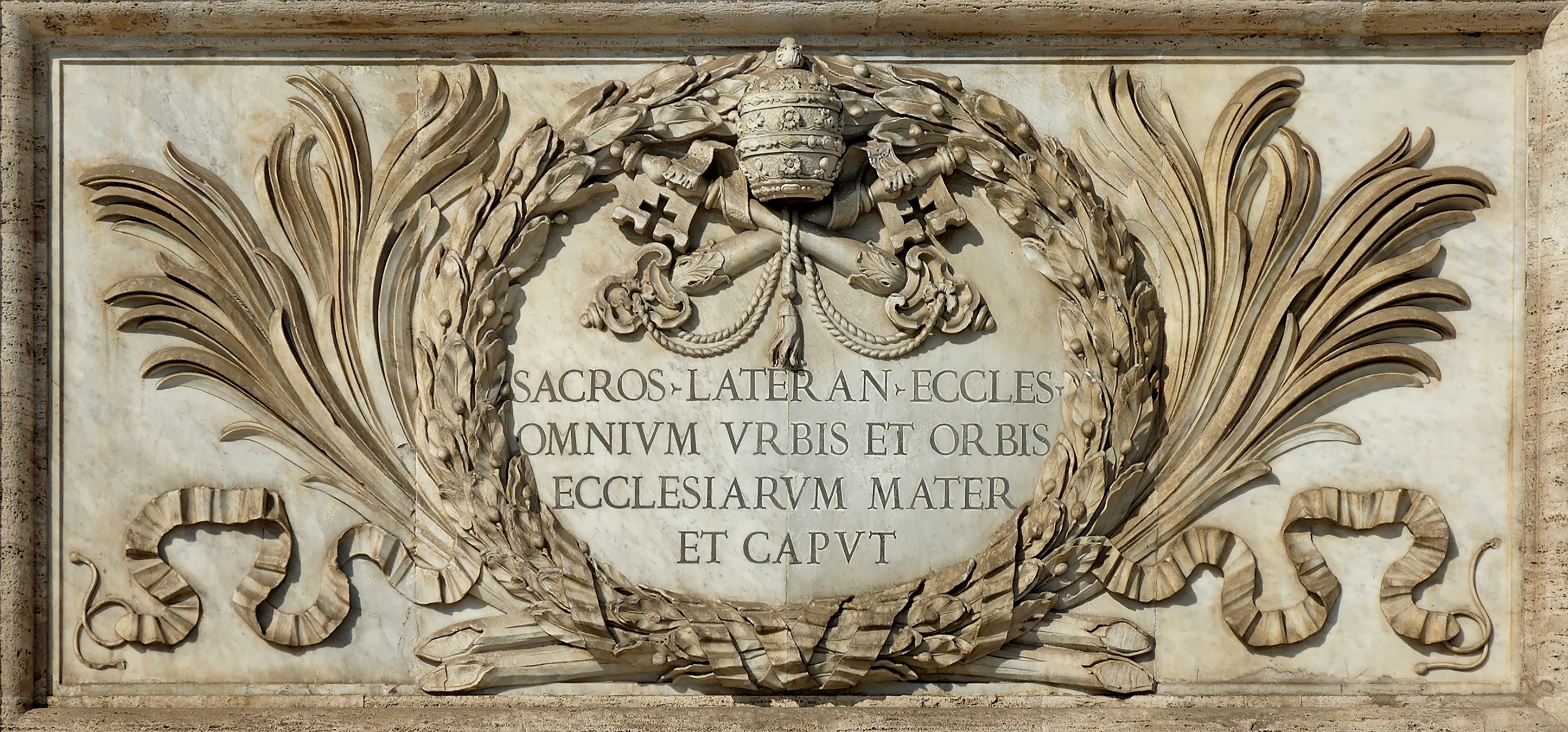
Inscription_Ecclesiarum_Mater_San_Giovanni_in_Laterano_2006-09-07St John Lateran
9 November 2014
1 Corinthians 3.9-11,16-17
Fr. Patrick Allen

+ + +

In February of the year 313, the Emperor of the Western Roman Empire, Constantine the Great, and Licinius, who had control of the Balkans, met and, among other things, issued a decree known as the Edict of Milan, which extended official toleration to the Christian religion. Property and money confiscated from Christians either by government officials or private citizens were to be restored or repaid, and, for the first time, Christians would be free to worship openly and without fear of reprisal.

That same year Constantine gave the estate of the ancient Roman Laterani family, which had come to him by marriage, to the Bishop of Rome, Pope Miltiades. He had a basilica, baptistry, and patriarchate built for him. The Basilica was completed in the year 324 and dedicated to the Most Holy Savior. Later dedications to both St. John the Baptist and St. John the Evangelist would be added, so that today it is commonly referred to as “St. John Lateran.”

The Lateran patriarchate was the residence of the Popes from Miltiades until they abandoned Rome for Avignon for the better part of the 14th century. When Pope Gregory XI returned, the Lateran was in such poor condition that the Pope made his residence next door the Vatican basilica, St. Peter’s – which Constantine had also built, and where the Popes would continue to reside until Pope Francis decided to move in to the hostel down the hill.

The Popes have moved their residence, but the Lateran Basilica remains the Cathedral Church of the Bishop of Rome – not St. Peter’s, as is often thought. Though it has been repeatedly destroyed by and rebuilt after the invasions of Goths and Visigoths, devastating earthquakes and fires, and our old friend deferred maintenance, it is the oldest Church of the Latin rite, the mother church of Christendom. As is engraved in the wall over the main doors, “Most Holy Lateran Church, of all the churches in the city and the world, the mother and head.” And today throughout the Universal Church is the Feast of the Dedication of the Lateran Basilica, which takes precedence over the Sunday.

It perhaps seems odd, particulary to us who have only recently come into full communion with the Church, to venerate a building, particularly on the Lord’s Day. But we honor the Lateran Basilica as an expression of love and veneration of the Church of Rome, and her bishops the Popes – because, as St. Ignatius of Antioch wrote more than 200 years before the edict of Milan and Constantine’s gift to Pope Miltiades, the Church of Rome “presides in love” over all the churches.

And by venerating this building, the Church calls us to remember that the building itself, beautiful as it is (and it is!), is made of dead stone, and is but a token of the living Church – which is a community, the “people of God,” as the Second Vatican Council taught so insistently.

Insistently – and Biblically, we might add. Pope St. Clement, writing about the year 100, called Saints Peter and Paul the “greatest and most righteous pillars” of the Roman Church, and already in their writings we see the Universal Church understood as a “spiritual building.”

So, in our epistle lesson we have heard St. Paul say to the Corinthians, You are God’s building… with no other foundation [than] Jesus Christ. And, you are God’s temple… and God’s Spirit dwells in you… God’s temple is holy, and that temple you are.

And in his first epistle, St. Peter invites us to “Come to [Jesus], to that living stone, rejected by men but in God’s sight chosen and precious; and like living stones be yourselves built into a spiritual house” (1 Pet 2.4,5).

God’s building… “Living stones built into a spiritual house.” It has been 24 years since I saw the Lateran Basilica in person, and to be honest, I was too young and stupid to appreciate all that I was seeing.  But just last week I was in St. Louis, Missouri, which used to be called “the Rome of the West,” believe it or not, because of its strong Catholic identity, and because it is mother to ao many of the midwestern dioceses.  And the Archdiocese is home to the beautiful neo-Byzantine Cathedral Basilica of St. Louis. The interior of that basilica is covered, floor to dome, with stunning mosaics – 41.5 million pieces of glass tesserae, in 7,000 colors, covering 83,000 square feet.

Any one of those small pieces of glass would, I suppose, have its own beauty and worth; if you saw one lying on the sidewalk, you might tempted to pick it up – but maybe not. But when they are fitted together by a skilled craftsman, they become, if you’ll forgive the worn out cliche, so much more, infinitely more, than the sum of their parts. Each tessera is elevated; it’s individuality is maintained, yet wonderfully transcended and transfigured. And so it is with the Church, as baptized individuals – each a precious stone in his or her own right – yield themselves in faith and obedience to the loving Craftsman, an ordered community of persons is revealed as God’s building, God’s holy temple, where God’s Spirit dwells.

Pope Benedict XVI put it this way: “The beauty and harmony of churches, destined to render praise to God, invites us human beings too, though limited and sinful, to convert ourselves to form a ‘cosmos,’ a well-ordered construction, in close communion with Jesus, who is the true Holy of Holies” (Angelus, 9 November 2008).

That “conversion” into a “well-ordered construction” of which the Pope Emeritus speaks is not, though, some kind of sterile rule-following or “do-goodery,” to use a phrase of Pope Francis’, that yields self-righteousness and – paradoxically but inevitably – hate. Nor is it a “hostile inflexibility [so that one] closes oneself within the written word,” as the Holy Father said at the Synod on the Family.

Rather, that conversion is instead an act of love, many acts of love in concert, but always responding to, conforming to, and called forth by, God’s original and perfect act of love for us – which is why St. Paul warns us to let each man take care how he builds upon it; for no other foundation can anyone lay than that which is laid, which is Jesus Christ.

And so the community of the baptized, God’s building, this “spiritual house” whose “living stones” we are, becomes most fully and truly itself in the Eucharist – in which that primal act of love, our “sure foundation,” Jesus Christ himself, gives himself to us in the Sacrament of his Body and Blood – so that we are transformed into what we receive, we become what we eat. As we will pray after our Communion, “that, by partaking of this Sacrament, we may be made the temple of your grace.”

And that is what God is making us into, as we yield ourselves to him in faith and love: carefully, patiently, skillfully fitting us together into the temple of his grace, built on the foundation of Jesus Christ.

+ + +

Sermon: All Souls’ Day 2014

All Souls’ Day
2 November 2014
Fr. Patrick Allen

+ + +

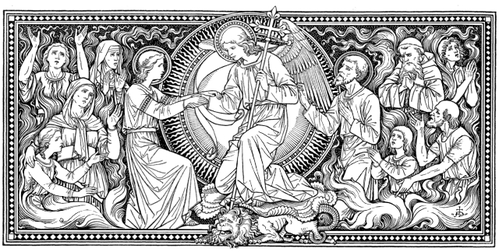
all soulsYesterday, the first of November, was of course All Saints’ Day – a day set apart in the Church for us to celebrate the witness and example of all those Christians who have gone before us as true martyrs or having lived lives of heroic virtue. But of course, this is not just a backward-looking exercise as we seek strength in their witness and example. No, we believe “in the communion of the saints,” which is happening right now. We celebrate their present company, their real encouragement, and especially their prayers.

So in just a few minutes, we will seek their intercession for us, and we will lift up our hearts to the heavenly realm where they are, and in the Holy Eucharist enter into the ceaseless worship of heaven, together with “angels and archangels and the whole company of heaven.”

Or we may think of St. Therese of Lisieux, dying so young of tuberculosis, who said, “My mission – to make God loved – will begin after my death… I will spend my heaven doing good on earth.”

“I will spend my heaven doing good on earth!” The saints are those known and unknown, formally canonized or not, who have been, as St. Paul has it, “conformed to the image of Christ,” who have been perfected in love, and enjoy the Beatific Vision. And there, in the Presence of God, they exercise a ministry of prayer for us.

But of course this is not the Mass of All Saints, but rather the Mass of All Souls – or “All the Faithful Departed.” And at this Mass we pay particular attention to the other side of this prayer ministry. To be sure, we give thanks for the lives of our departed loved one, and we may well mourn our own losses, but most especially we have a ministry to perform: to help the faithful departed, to encourage them, to love them. In a sense, we may spend our earth (some portion of it, anyway) doing good in Heaven.

All that Father gives me will come to me, is the promise that our Lord makes in today’s Gospel. And the Lord, in his goodness and mercy, is fitting us for that great day. That process, in which we cooperate with his grace, is called “conversion” – and the goal, the promise, is that we will each in our own particular way, be like the saints, conformed to the image of Christ – that we will love as he loves.

We might think of it in terms of last Sunday’s Gospel, in which Jesus was asked which is the greatest commandment in the law. And you remember his reply: “Thou shalt love the Lord thy God with all thy heart, with all thy, soul, and with all thy mind. This is the first and great commandment, and the second is like unto it: thou shalt love thy neighbor as thy self.” And that is not, at its deepest level, so much a commandment as it is a promise. “Thou shalt love,” God promises his people.

But immediately, we see the rub. For the vast majority of us, upon reaching the “grave and gate of death,” we do not yet love perfectly, whole heartedly, and have in our own individual ways and to varying degrees resisted God’s grace, so that we do not love as Christ loves, do not do as he would do. Not conformed to the image of the Son, we are not yet ready for the Father’s presence.

But it is not just that there is, so to speak, an objective moral shortfall in our lives. Our problem is not just that holiness is not only required objectively, but that it is also desired subjectively – it’s what we want. And perhaps the best way to measure the progress of our sanctification or the depth of our conversion is to consider to what degree we actually desire holiness and wholeness. Regardless of how we struggle and often fall and experience deep conflicts within our hearts, we know what we want – or, in my case, I know what I want to want: to love freely and without reservation, to leave behind mixed motives, for our appetites and desires to be brought in to good order and subject to reason and love. We long, in our saner moments, for purity, to be rid of anything that would keep us from perfect communion with a loving Father.

C.S. Lewis pondered this dilemma of arriving at Heaven’s gate with our love still imperfect, with our desire for holiness still unrealized, and had this to say:

Would it not break the heart if God said to us, ‘It is true, my son, that your breath smells and your rags drip with mud and slime, but we are charitable here and no one will upbraid  you with these things, nor draw away from you. Enter into the joy’? Should we not reply, ‘With submission, sir, and if there is no objection, I’d rather be cleaned first’ (“The Business of Heaven”).

But God will not break our hearts, and he, incredibly, desires our fellowship and presence, wants our own longings for holiness and wholeness to be fulfilled. And the name that the Church gives to the Father’s love at this point is “Purgatory.”

The teaching of the Church in this matter is actually pretty slim as to content, though it is filled with great comfort and common sense. In fact, the Catechism sums up only three things the Catholic Christianity insists upon with regard to Purgatory.

The first, I hope should be clear from all that has gone before – simply that Purgatory is about purification for heaven (which all Christians – Catholic and Orthodox and Protestant agree is necessary), not about punishment and Hell. Actually, I should be even clearer than that – the Church teaches that Purgatory is Heaven, at least its narthex or doorway or, perhaps, its mudroom. It is part of the process of salvation, the application of redemption – and again, something for which God’s friends desire as “the hart longs for the waterbrook” (Ps 42). So Purgatory is forward looking, not backward. It is for those who are being saved, not for those who have chosen their own way.

Secondly, Purgatory may involve some degree of pain and discomfort. This should not be surprising and is, I think, common sense. Sanctification on this side of the grave involves pain and discomfort – at least in the sense of striving and straining towards the goal and of disciplining the appetites. And also in this sense: it involves necessarily the revelation to ourselves of our own horrifying sinfulness and does so against the backdrop of a much clearer vision of God’s holiness and love than we can have in this life. We can perhaps think of this in terms of confession – which is nothing other than being truthful with God about our sin, and, as we know, sometimes the truth, especially the truth about ourselves, hurts, but truth, honesty, is always the necessary precondition for healing and reconciliation. A Puritan theologian called confession “the vomit of the soul” – it’s not pleasant, but it gets the badness out, and we’re glad and relieved to have it out.

But if Purgatory must necessarily involve pain, it must also necessarily involve pleasure and joy because it brings us to the Source of pleasure and joy. Indeed, St. Catherine of Genoa, the Church’s great teacher about Purgatory, insisted that these pleasures must outweigh any pains:

Thus, according as the rust diminishes and the soul is laid bare to the divine rays, happiness is augmented. The one grows and the other wanes until the time of trial is elapsed . . . With regard to the will of these souls, they can never say that these pains are pains, so great is their contentment with the ordinance of God, with which their wills are united in perfect charity (Treatise on Purgatory).

And finally, the Church has always believed that just as by God’s design and command prayer aids our growth in grace and holiness on this side of the grave, so prayer can aid growth in grace and holiness in Purgatory. How does that work – how do our prayers help? In the same way that any prayer works. God has ordered his world in such a way that our prayers have some effective part in its – and mine and your – unfolding history. As Pascal said, in prayer God “gives us the dignity of causation.”

In the fourth century, St. John Chrysostom encouraged his flock in Constantinople, “Let us help and commemorate them. If Job’s sons were purified by their father’s sacrifice, why would we doubt that our offerings for the dead bring them some consolation? Let us not hesitate to help those who have died and to offer our prayers for them” (Hom. in 1 Cor. 41,5:PG 61,361; cf. Job 1:5).

So let us exercise our full dignity! Let us pray!

Love demands that we pray, and the highest prayer of the Church is the Eucharist, when we unite ourselves to Christ’s sacrifice. And it is here, in the Mass, that the veil between this world and next is lifted, and we are there before Christ’s throne with “Angels and Archangels and the whole company of heaven.” The Communion of Saints is actualized. United with Christ, we are united with one another. Our love and desire and prayer for those we love is lifted up to the Father in the Son’s perfect offering of himself on Calvary’s cross – and theirs for us.

And so it will be until that great Day when God will bring all of us finally, fully, and forever to Himself. All that the Father gives me will come to me, he has promised. And so we shall: we will see Christ, and be like him, for we shall see him as he is.

In the meantime, with all who hope in him, we purify ourselves, even as he his pure – trusting that God in his mercy and grace will provide for us and for those whom we love whatever is lacking in our sanctification, and that the One who began a good work in us will bring it completion in the Day of Christ.

+ + +

The life that saves you may be your own!

download

Yesterday, Wesley Hill, an Anglican New Testament scholar teaching at Trinity School for Ministry, published a reflection on God’s grace given to us in and through the everyday-ness of our lives – those things, those duties, those neighbors (whom perhaps we share our beds and homes with) – which constitute the normal furniture of our lives. His jumping off point is St. Paul’s enigmatic comment that women will be “saved though childbearing”:

Then another housemate sat down next to me. He asked me questions. He told me about his day. He helped me do dishes. Insistently, and simply by his physical presence, without any verbal articulation of what he was doing or why, he asked me to notice him, to talk with him and listen to him. At that moment, I didn’t especially want to. I wanted to get back to work—to get back to preparing tomorrow’s theology lesson, to get back to the theological novel I would read after closing the computer with my file of lecture notes. It only dawned on me later that perhaps this was, in my childless state, my analogue to being saved “through childbearing.”

Calvin’s gloss on 1 Timothy 2:15 speaks of the reference to childbearing, with its concomitant gestures to “faith and love and holiness, with modesty,” as indicating “in what way God conducts us to salvation, to which he has appointed us through his grace.” These children, in other words, inthese daily circumstances, are the path on which we are led to receive our spiritual rescue. Soskice again: “It is by being at the disposal of another that we are characteristically drawn out of ourselves.” We are saved, that is, by traversing the way of what Iris Murdoch has called the “extremely difficult realisation that someone other than oneself is real.” We are saved in and through such patient attention, not outside of it or beyond it. Perhaps we are saved in the early mornings, as the coffee cools, as well as in the lecture halls and carpools.

I strongly encourage you to read the whole thing! The essay also reminded me that I tried to make a similar point in a homily I preached last Advent, though, I see now, much less elegantly and effectively than did Professor Hill. In any case, since I never got around to posting it at the time, here ’tis.

– Fr. Patrick Allen


I Advent (A)
1 December 2013
St. Mary’s/Corpus Christi
PSA

This first Sunday of Advent reminds us that the Christian story is not over yet; there is more to come.  In Advent, we very intentionally place ourselves in solidarity with our elder brothers and sisters in the faith – those faithful Israelites – like Simeon and Anna and Elizabeth, Joseph and our Lady – were waiting, longing, and looking for “the consolation of Israel”, and saw and welcomed that Consolation, that Christ, when he arrived, poor and in a manger.  Because doing so teaches us to wait and long and look for him when he shall return “in power and great glory to judge both the quick and the dead.”  The Christian story, which is the world’s true story, moves forward; there is another act yet to come – and Advent reminds us of that.

Our Advent preparation for the feast of our Lord’s Nativity is a picture in miniature of what our preparation for his Return – which is to say, the entirety of our lives – ought to be: expectant; hopeful; watchful.  Awake and prepared, so that “without shame or fear we may rejoice to behold his appearing.”  In this morning’s Gospel lesson, our Lord is very bluntly warning us to be ready, to be prepared: Therefore you also must be ready; for the Son of man is coming at an hour you do not expect.

It is, I know, difficult to keep any kind of an Advent in America, when the religious Holy Day has been swamped by a no-holds-barred retail free for all and Christmas trees are dumped on the curb on St. John’s Day.  But if we will give ourselves to it, teach ourselves, in the midst of all the bustle and busy-ness, to keep a holy Advent, it will form us, sharpen our senses, lift up our heads and our hearts so that, like those elder brothers and sisters in the faith, we will see and welcome him when he comes.

Now that can happen, Advent can do its work, in a number of ways – but I can’t help but notice that in this Gospel lesson, the emphasis falls on the mundane, the everyday; the emphasis falls, if you’ll indulge the paradox, on the unemphasized.  Notice what our Lord says.  Making the comparison of his own return to the days of Noah, he says, in those days before the flood they were eating and drinking, marrying and giving in marriage – in other words, they were living their lives, as of course, were Noah and his family.

And when he looks forward to the day of his return, he says two men will be [at work] in the field… two women will be grinding at the mill – in other words, just living their lives.  Their days are filled by the very same things, yet one is prepared and taken, and the other left, and Jesus doesn’t mention any other difference between them.  Both their days were filled with work and the necessities of life: the joys and obligations of family, maintaining a home, the morning and evening commute, getting the children to school and practice and lessons, watching whatever the ancient Middle-Eastern equivalent of college football on Saturday was – all the same things that our own days are filled with.  But one will be taken and the other left.

The point is that the watchfulness our Lord urges upon us, the preparedness we must develop, does not mean jettisoning our everyday lives.  And what I want to suggest is that the joys and responsibilities, the adventures and tedium of our everyday, normal lives, can be either the means of our faithful and joyful preparation for our Lord’s return, or the obstacles to it.  C.S. Lewis made just this point in the Screwtape Letters when his fictional demon Screwtape, advising his demon nephew Screwtape on how to tempt a human being to Hell, says regarding this particular human’s having fallen in love: “Like most of the other things which humans are excited about, such as health and sickness, age and youth, or war and peace, it is, from the point of view of the spiritual life, mainly raw material.”

To which I would add, as so also are the things we don’t get so excited about: working in the field, grinding at the mill, changing diapers and washing dishes, filling out forms, driving the carpool – all of it the raw material of our spiritual formation.  All those things are the little deeds we may do either with great love and praise or with disdain and distraction.  It depends, of course, on the attitude, the orientation of our hearts, we bring to the task.

Because our work, the ordinary tasks of domestic life, even the way in which we drive, all of these things are, in reality, opportunities to love and serve our neighbor – which is to say, they are opportunities to love and serve our Lord.  But that takes, of course, the constant and conscious application of the Advent discipline to our lives:  looking for our Lord, watching for him, ready to love him when he appears – as he does.

The Lord will come at the end of the age, at a day and hour neither we nor even the angels in Heaven know, to judge both the quick and the dead.  That is Advent’s ultimate horizon, the coming of our Lord for which he urged us to watch and prepare.  But the way to prepare, the way to watch, is to see and welcome the Lord in his nearer and quieter Advents.  “God walks among the pots and the pans,” St. Teresa of Avila told her fellow nuns.  And he comes among us in those in need – and who is not in need at least of a smile and cheerful word, if not a helping hand up or a merciful hand out?  And of course, in just a few more minutes, he will come among us in the Sacrament of the Altar, in the most ordinary of appearances, a bit of bread, a cup of wine, but really and substantially present among us.  Will we be prepared?

Again, it all depends on the orientation of our hearts – but that is determined by the degree to which we have understood the orientation of his heart, which is always to love, and to love to the end, giving himself on the cross for the life of the world, for my life and your life.  When that cup of suffering was placed before him, he was ready and prepared to drink it.

And how did that happen?  We of course are curious about our Lord’s childhood and young adulthood before that fateful day when he presented himself to John for baptism in the river Jordan.  But the Gospels are all but silent.  St. Luke simply places him within the context of the Holy Family and tells us that “he increased in wisdom and stature and in favor with God and man.”  Which is simply to say that Jesus learned love precisely in the midst of the everyday tasks and joys and sorrows of a normal life, as a faithful and obedient Son, and if not at work in the field or grinding at the mill, then in St. Joseph’s carpenter’s shop.  He cheerfully and diligently gave himself to his work in love and service to others, and thereby to his Father in Heaven.  At his work, day by day, for love, he hammered in nails, and when the day came, for love, he offered himself up and the nails were driven into him.

Well, tomorrow is Monday, and we are back to it: the field, the mill, the carpenter’s shop; the classroom, the office, the kitchen.  And Jesus will be there.  Let us watch for him and love him, so that on that great day when he returns in power and great glory, we may without shame or fear rejoice to behold his appearing.  Even so, come quickly Lord Jesus.

+ + +