Notes for the 3rd Sunday of Advent!

Gaudate Sunday

The Third Sunday of Advent is called Gaudate or “Rose” Sunday (for the color of the vestments reserved for this day and Laetare Sunday in Lent). Why? Pope Benedict XVI explains: ‘the Third Sunday in the Season of Advent, is called “Gaudete Sunday”: “rejoice”, because the Introit of Holy Mass takes up St Paul’s words in the Letter to the Philippians where it says: “Rejoice in the Lord always; again, I will say, Rejoice”. And immediately after he explains the reason, because “The Lord is at hand” (Phil 4: 4-5). This is the reason for joy… God’s “closeness” is not a question of space and time but rather of love: love brings people together! This coming Christmas will remind us of this fundamental truth of our faith and in front of the manger we shall be able to savour Christian joy contemplating in the newborn Jesus the Face of God who made himself close to us out of love.’

bambinelli

Bambinelli Sunday

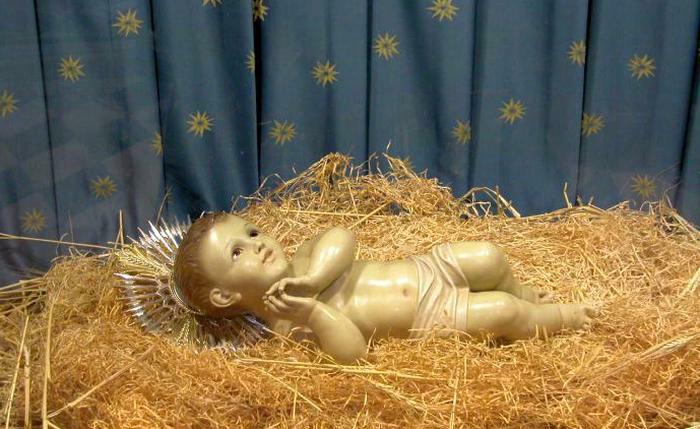
Each year on the Third Sunday in Advent, children in Rome gather with their families in St. Peter’s Square for Benedizione del Bambinelli.  The children bring with them the Bambinelli—the Christ Child—from their family’s Nativity scene.  At the noon Angelus, the Pope blesses the children, their families, and the figurines they have brought.  This year we will unite our hearts with the Holy Father’s and the families gathered with him for the blessing of our own Bambinelli at the conclusion of Mass today.


Bambinelli Sunday

bambinello_bethlemme

Each year on the Third Sunday in Advent (15 December – “Gaudate Sunday”), children in Rome gather with their families in St. Peter’s Square for Benedizione del Bambinelli.  The children bring with them the Bambinello—the Christ Child—from their family’s Nativity scene.  At the noon Angelus, the Pope blesses the children, their families, and the figurines they have brought.  This year we will unite our hearts with the Holy Father’s and the families gathered with him for the blessing of our ownBambinelli.  Bring your Christ Child on Sunday, and the children will present them for a blessing by Fr. Allen at the conclusion of Mass.

welbornCheck out Amy Welborn’s wonderful Bambinelli Sunday children’s book, with beautiful water color illustrations by Ann Kissane Engelhart.

The blessing of the “Bambinelli” [Baby Jesus figurines] as they are called in Rome, reminds us that the crib is a school of life where we can learn the secret of true joy. This does not consist in having many things but in feeling loved by the Lord, in giving oneself as a gift for others and in loving one another. Let us look at the crib. Our Lady and St Joseph do not seem to be a very fortunate family; their first child was born in the midst of great hardship; yet they are full of deep joy, because they love each other, they help each other and, especially, they are certain that God, who made himself present in the little Jesus, is at work in their story. And the shepherds? What did they have to rejoice about? That Newborn Infant was not to change their condition of poverty and marginalization. But faith helped them recognize the “babe wrapped in swaddling clothes and lying in a manger” as a “sign” of the fulfilment of God’s promises for all human beings, “with whom he is pleased” (Lk 2: 12, 14).

This, dear friends, is what true joy consists in: it is feeling that our personal and community existence has been visited and filled by a great mystery, the mystery of God’s love. In order to rejoice we do not need things alone, but love and truth: we need a close God who warms our hearts and responds to our deepest expectations. This God is manifested in Jesus, born of the Virgin Mary. Therefore that “Bambinello” which we place in a stable or a grotto is the centre of all things, the heart of the world. Let us pray that every person, like the Virgin Mary, may accept as the centre of his or her life the God who made himself a Child, the source of true joy.

–Benedict XVI, Benedizioni del Bambinelli 2009

benedizione

Meet the New Mass!

chalice

Meet the New Mass!

Join us for Supper & an Introduction to

DIVINE WORSHIP: The Order of Mass for the use of the Ordinariates
established under the auspices of Anglicanorum coetibus.

marks_hedera

Sunday, 24 November
5.30PM St. Mary’s Parish Hall
89 Hasell Street

Homily: 25 August 2013 (Ordinary 21c)

Ordinary 21c
Lk 13.22-30
25 August 2013
St. Mary’s
Fr. Patrick Allen
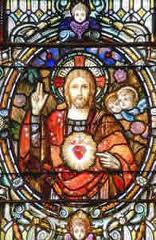
sacred heart“The road to hell,” we have all heard since we were children, “is paved with good intentions.”  There is another similar saying one often hears in church circles, attributed widely to various saints running from St. Athanasius back in the 4th century all the way up to Alphonsus Ligouri in the 18th, that “the floor of hell is paved with the bones of erring priests with skulls of bishops as lamp posts.  I used to think that was funny, too, before I became a priest.”

Well, and sadly, there is something there that rings true, and that might be so for lots of reasons.  C.S. Lewis gets, in his usual incisive manner, at one possible reason in his wonderful book The Great Divorce, a highly imaginative reflection on the Christian understanding of Heaven and Hell.  In the book, each day a bus brings some denizens of Hell right up to the outskirts of Heaven, where they can get out and walk around, and they are always given the opportunity of staying.  On one of these trips, one of the tourists to get off the bus is, or had been, a bishop of the Church of England, which was Lewis’ own communion.  When urged by an old friend, now a saint in light, to repent, believe the Gospel, and enter into the bliss of Heaven to “see the face of God,” the Bishop admits to being intrigues by the idea, but then says,

“Bless my soul, I’d nearly forgotten.  Of course I can’t come with you.  I have to be back next Friday to read a paper.  We have a little Theological Society down there.  Oh yes!  There is plenty of intellectual life.  Not of a very high quality, perhaps.”

Rather than see the face of God and be united to the very life of God, the poor man gets back on the bus for the return journey.  He is intrigued by the idea of God – really, by his own ideas of God – but not especially interested in God himself.  Instead of actually talking to God, he would prefer to talk about God.

Now to be sure, we need good theologians, and we need clear thinking and accurate teaching, even and especially about Heaven and Hell.  But the point of theology, of theologizing, of talking about God, of preaching, ought to be to lead us to the person of God.  Honest questions are good, and ought to be asked, and the Church provides room for and welcomes honest questions.  But, as G.K. Chesterton said, the object of opening one’s mind, as of opening one’s mouth, is to close it again on something solid.  And, as the tragicomic character of Lewis’ bishop suggests, questions, talk, abstractions can sometimes, for some of us (perhaps especially priests and bishops) become a cloak for avoidance, a strategy of evasion.

We see more than a hint of this in our Gospel lesson this morning.  Our Lord, with his face set like flint, is passing through towns and villages, teaching as he [goes] and making his way to Jerusalem, and he is asked, Lord, will only a few people be saved?” 

Will only a few people be saved?  It’s a good and common question, and there are good reasons for asking it, and many fine theologians in the history of the Church have reflected upon it with profound and provocative results.  But what I’d like us this morning to notice is that when asked that very interesting quesiton directly, our Lord does not even begin to answer it.  He has no interest in having an abstract theological discussion on the possible population of Hell.  Instead he looks at his questioner – and at you and me – and cutting through every strategy of evasion and avoidance says, Strive to enter by the narrow gate.

It’s as if Jesus is saying to us, the good question, the first and immediate question, is not, Will only a few be saved, but, “Will you be saved?” 

Strive to enter by the narrow gate.  “Strive” – that’s a daunting word, isn’t it?  And problematic – it seems opposed to grace and the free offer of the Gospel.  And there’s a lot, I suppose, to say about what that striving might mean, what it might look like.  But when our Lord illustrates his point he goes negative, showing us what it is not, which is presumption based on mere acquaintance:  You will say, ‘We ate in your company and you taught in our streets;’ then he will say to you, ‘I do not know where you are from; depart from me all you evildoers!’

This should be a warning specially taken to heart by those of us in the Church, and perhaps even more so by those of us called to Holy Orders.  It is perfectly possible to have a very polite, very gentile, very religious, at least in the outward Mass-attending trappings, acquaintanceship with Jesus, but yet not to have known him, not to have been his friend.  There is no question of simply being “in the club” – not by virtue of Jewish birth and observance, as in the case of our Lord’s questioner, not by getting one’s card punched in baptism in our own case.  Baptism is the necessary beginning that frees us for a life of discipleship.

Indeed, this is why the gate is narrow – no one can fit through while carrying presumption.

Benedict XVI put it this way:

“When we consider it, in effect, the way of reasoning of Jesus’ interlocutors is always with us: the temptation to think of religious practice as a source of privileges and certainties is always waiting in ambush for us. In truth, Christ’s message goes in exactly the opposite direction: Everyone can enter into life, but the gate is “narrow” for everyone. There is no privileged group. The way to eternal life is open to all, but it is ‘narrow’ because it is demanding, it requires commitment, self-denial and [the] mortification of one’s own egoism.”

As opposed to acquaintanceship, the Pope Emeritus went on to say, “true friendship with Christ is expressed in one’s way of life.”

And when we think of it in those terms, as friendship with Christ, this idea of striving begins to make sense.  We can see it not in opposition to grace, but as a corollary to love.  Acquaintanceship is an accident of timing, but friendship – while it should certainly include affection – is also an act of the will.  Actually, of repeated, habitual acts of the will.  Friends act, habitually and, necessarily, sacrificially, for the good of one another.  Friendship brings obligation.  Friends have claims on one another.  Friendship is not a status, a privilege – it is a way of life.

And isn’t this the way the grace of the sacrament of marriage works itself out – over time, as a man and a woman learn together what it means to love, habitually and sacrificially to act for the good of the other, and so, in the end, become lovers – as in “people who love”, persons fit for the Kingdom of Heaven because they have been conformed to the image of Christ?  Marriage is, we might say, “demanding, it requires commitment, self-denial and [the] mortification of one’s own egoism.”  It, love, requires a certain amount of striving.

Strive to enter by the narrow gate.  It is a little bit daunting.  Jesus is calling us out from behind our abstractions, pushing us beyond merely talking and theorizing about love to the real thing.  But of course, when it comes to love, Jesus is the Real Thing; he is the True Lover who pours himself out for his beloved, for you and for me.

And it may be that the most important thing this passage has to say for how we understand entering the Kingdom of God actually comes in what we might be tempted to pass over as just St. Luke’s introductory scene setting:  Jesus passed through towns and villages, teaching as he went and making his way to Jerusalem.  We might be tempted to pass it over, but it is programmatic for the whole discussion.  He is on his way to Jerusalem, on his way to the cross, for love’s sake.

That word “strive” in our English translation is agonizomai in St. Luke’s Greek – you can hear in its root our word “agony.”  Jesus is on his way to Jerusalem, where, by the agony of his love, his “blessed passion and precious death,” he will open the narrow gate of salvation.  Let us strive – let us love – to enter in. 

+ + +
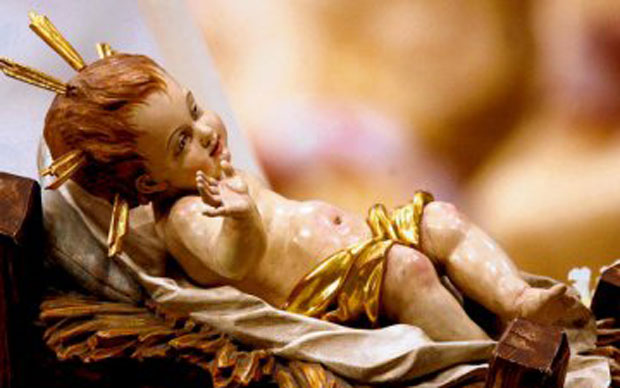
Novena to Our Lady of Walsingham for Our Inaugural Mass

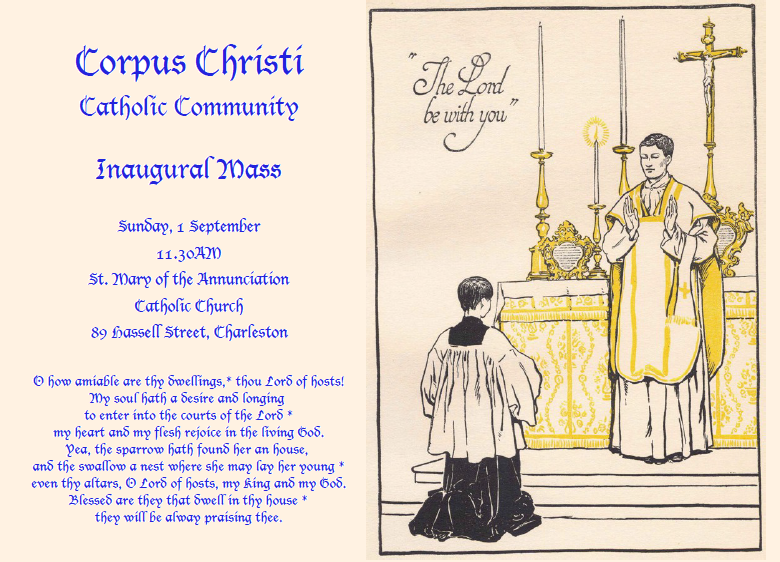
Please join our community in praying this novena to Our Lady of Walsingham beginning Wednesday, 21 August, for our inaugural Holy Mass on Sunday, 1 September, 11.30AM at St. Mary of the Annunciation Catholic Church.


Novena to Our Lady of Walsingham

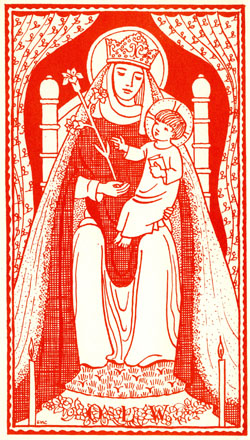
OLW_enidDevotion to Our Lady of Walsingham is always centered on the Mystery of the Annunciation. It was at the Annunciation that Our Lady accepted God’s invitation to be the Mother of God, the Theotokos. She gave herself over to God’s will and conceived by the Holy Spirit. By this same Holy Spirit Mary always leads us to Jesus, and her prayers help us say “yes” to God’s will in our lives even as she did at the Annunciation.

Ancient Walsingham Prayer

O alone of all women, Mother and Virgin, Mother most happy, Virgin most pure, now we sinful as we are, come to see thee who are all pure, we salute thee, we honour thee as how we may with our humble offerings; may thy Son grant us, that imitating thy most holy manners, we also, by the grace of the Holy Ghost may deserve spiritually to conceive the Lord Jesus in our inmost soul, and once conceived never to lose him. Amen.

¶ The Litany of Our Lady of Walsingham follows.

Litany of Our Lady of Walsingham

Lord have mercy on us,   R/ Lord have mercy on us.
Christ have mercy on us,   R/ Christ have mercy on us.
Lord have mercy on us,   R/ Lord have mercy on us.
Christ hear us,   R/ Christ graciously hear us.
God our Father in heaven,   R/ have mercy on us.
God the Son Redeemer of the world,   R/ have mercy on us.
God the Holy Spirit,   R/ have mercy on us,
Holy Trinity , One God,   R/ have mercy on us.
Mary,   R/ Pray to the Lord for us.
Mary without sin,   R/ Pray to the Lord for us,
Mary God’s Mother,   R/ Pray to the Lord for us,
Mary the Virgin,   R/ Pray to the Lord for us.
Mary taken to heaven,   R/ Pray to the Lord for us.
Mary at Bethlehem,   R/ Pray for all mothers.
Mary at Nazareth,   R/Pray for all families.
Mary at Cana,   R/ Pray for all married couples.
Mary at the cross,   R/ Pray for all who suffer.
Mary in the upper Room,   R/ Pray for all who wait.
Mary, Model of womanhood,   R/Pray for all women.
Woman of faith,   R/ Keep us in mind.
Woman of Hope,   R/keep us in mind,
Woman of charity,   R/keep us in mind.
Woman of suffering,   R/ Keep us in mind.
Woman of anxiety,   R/ Keep us in mind.
Woman of humility,   R/ Keep us in mind.
Woman of poverty,   R/ Keep us in mind.
Woman of purity,   R/ Keep us in mind.
Woman of obedience,   R/ Keep us in mind.
Woman who wondered, R/ Remember us to God.
Woman who listened,   R/ Remember us to God.
Woman who followed him,   R/ Remember us to God.
Woman who longed for him,   R/ Remember us to God.
Woman who loves him,   R/ Remember us to God.
Mother of God,   R/ Be our Mother always.
Mother of the church   R/ Be our Mother always.
Mother of all priests,   R/ Be our Mother always.
Mother of all missionaries,   R/ Be our Mother always.
Mother of all women consecrated to your son, R/ Be our Mother always.
Mother of Ty Mam Duw,   R/ Be our Mother always.
Mother of all men,   R/ Be our Mother always.
Mother we need you,   R/ Be our Mother always.
Mother who went on believing,   R/ We thank God for you.
Mother who never lost hope,   R/ We thank God for you.
Mother who loved to the end,   R/ We thank God for you.

Alone of all women, Mother and virgin,
Mother most happy, Virgin Most pure,
now we, impure as we are, come to see you who are all pure: we salute you: we worship you as how we may with our humble offerings: may your Son grant us that, imitating his most holy manners, we also by the grace of the Holy Spirit, may deserve spiritually to conceive the Lord Jesus in our inmost soul, and once conceived, never to loose Him. Amen ( Prayer used by Erasmus at Walsingham)

Prayer to Our Lady of Walsingham

O blessed Virgin Mary, Our Lady of Walsingham, Mother of God and our most gentle Queen and Mother, look down in mercy upon us, our parish, our country, our homes, and our families, and upon all who greatly hope and trust in your prayers, especially Corpus Christi Catholic Community. By you it was that Jesus, our Savior and hope, was given to the world; and he has given you to us that we may hope still more. Plead for us your children, whom you did receive and accept at the foot of the Cross, O sorrowful Mother. Intercede for our separated brethren, that with us in the one true fold they may be united to the Chief Shepherd, the Vicar of your Son. Pray for us all, dear Mother, that by faith fruitful in good works we all may be made worthy to see and praise God, together with you in our heavenly home. Amen.

Our Lady of Walsingham, Pray for us.


Assumption Day: Get Thee to Mass!

asam-assumption1

Mary is taken up into Heaven:

The Angels rejoice and glorify the Lord, alleluia!

15 August is the Feast of the Assumption of the Blessed Virgin Mary – a Holy Day of Obligation and occasion of joy for all Catholics.  Mass at St. Mary’s: 7.00AM & 5.30PM.  Mass at the Cathedral: 12.05PM & 6.00PM.


Homily: Ordinary 19c

Ordinary 19c
Lk 12.35-40
11 August 2013
St. Mary’s
PSA

In this morning’s Gospel lesson, our Lord gives us a basic history lesson. It’s not the sort of a “in 1492 Columbus sailed the ocean blue” (or, less trivially, that in August of 1789 this property was conveyed to the trustees of Charleston’s Roman Catholic Community) sort of lesson. It’s more of a lesson in what we might call “meta-history.” Our Lord is not concerned so much with past events of history, but rather with what history is, where it is going, and how that reality, that understanding of history, ought to re-order the lives of his disciples: Gird your loins and light your lamps and be like servants who await their master’s return from a wedding, ready to open immediately when he comes and knocks… You also must be prepared, for at an hour you do not expect, the Son of Man will come.

This is a terse reminder – and really a little late-summer foretaste of Advent – that history is not, as the pagan Greeks imagined, an endless cycle of turning and returning – lather, rinse, repeat. Nor is it simply an endless procession of years, centuries, and millenia till the sun burns itself out and eventually the cosmos collapses in upon itself. Nor is history, as the cynic had it, just one damn thing after another. Rather, history is a story, a divine drama, with a beginning, middle, and an end – that end, at an hour we do not expect – when Christ “will come again in glory to judge the living and the dead and his kingdom will have no end.”

History is going somewhere, it will end, and it has an end – a goal: the Son of Man will come. Therefore, Jesus says, You also must be prepared.

The point of this history lesson is that our choices matter. It lends a certain urgency, a meaningfulness, to our days. If history is just an endless repeating cycle, or just an endless procession of years, then who cares? There is nothing to strive for, nothing to fear, nothing at stake – like striking out or hitting a home run in a children’s game where no one is keeping score.i

And the danger here, I think, is not that believing the householder is permanently delayed, we will indulge our worst animal desires and savage appetites as the deadly sins of anger and lust take full sway – though in some ages that was the result. In our own time, though, I think we are much more likely simply to let the days, months, and years slip by in the pursuit of…nothing much. As Vaclev Havel said, “The tragedy of modern man is not that he knows less and less about the meaning of his own life, but that it bothers him less and less.”ii We will stare at screens, idly clicking across the internet ethers. We will obsess over minutiae. Sloth, more than anger or lust, is the deadly sin of the indolent West in our age.

Theologian Rusty Reno imagines the whispering voice of sloth like this:

All things are sanctified by the Lord, and one could just as well worship on the golf course as in a sanctuary made by human hands.” Or: “God is love, and love affirms; therefore, God accepts me just as I am. I need not exercise myself to change.” In our day, these temptations seem far more dangerous than Emerson’s “trust thyself.” After all, how many people, believers or unbelievers, wish to reign anywhere, in heaven, hell, or even in their own souls? Few, I imagine. Most of us just want to be left alone so that we can get on with our lives. Most of us want to be safe. We want to find a cocoon, a spiritually, psychologically, economically, and physically gated community in which to live without danger and disturbance. The care-free life, a life a-cedia, is our cultural ideal…iii

This is why we need our Lord’s history lesson. If he is coming again and “will judge the living and the dead,” if he should come in the second or the third watch and find them prepared in this way, blessed are those servants, then this life – this very day and the choices I make in it – mean something, and it is time to rouse ourselves and act.

Blessed are those servants, Jesus says in this morning’s little parable, whom the master finds prepared in this way. That “in this way” is interesting, isn’t it? It reminds us that we are, in fact, always preparing, always becoming. The choices I make today have a lot to do with the sort of person I will be tomorrow, and the sort of choices that person will be apt to make. And if I am not prepared in the way of love, then I will be prepared in the way of something else – something that is not love.

This, of course, is just what we see in Dante – in the Inferno, it’s not so much that the particular punishments of hell fit particular sins, but rather that sinners have become their sins: the miser has become his greed. The murderer is lost inside his violence. It’s not that they are beyond forgiveness, beyond God’s mercy, but they are beyond desiring it.iv

And the same is true of the saints in Heaven, but in reverse. Having given themselves over to the practice of love, they have attained to the true freedom which is actually the incapacity to will anything other than the good of themselves and their neighbors. They have been conformed to love.v

So the question is, what sort of preparation are we making? Who do we want to be, what sort of persons do we want to be, when the master returns? Well, saints, of course. And how does that happen? One choice at a time. In “small deeds,” as St. Therese of Lisieux said, “done with great love.” So that, finally, carried along by God’s grace, we become love – the very image of the One who is Love Himself.

Love Himself – that is the master who is returning, and for whom we prepare. And if we are ready, “loins girded and lamps lit,” and open to him when he knocks – what happens? Love pours himself out for us: Blessed are those servants whom the master finds vigilant on his arrival. Amen, I say to you, he will gird himself, have the servants recline at table, and proceed to wait on them.

And that is the beginning and the ending of our preparation: the contemplation of him who came “not to be served but to serve,” who gave himself for us. That is the bracing tonic that will shake us out of our slumber, and cure our addiction to comfort and a carefree life, so that we can live a true life, a life of meaning and purpose, even if its stage is only our own home, its characters our own family and neighbors. The contemplation of his character – of his truth, beauty, and goodness – will form our character. And to live a Christian life, to be a vigilant servant, is nothing but our day by day, intentional, existential “Yes” to his love.

In this little parable, our Lord points us to history’s far horizon when, with great glory, the Son of Man will come. But there are also those nearer and anticipatory comings, when, like vigilant servants, we may also rise to answer his knock. He comes – he comes in the everyday encounters with the naked and hungry and sick, whom to clothe and feed and comfort is to clothe and feed and comfort Christ himself.

And of course there is another near horizon of his coming – and of that coming we do know the hour. He will come among us, on this altar, in just a few more minutes. And though he is Master and Lord, he invites us, his servants, to recline at his table – to kneel at this rail – where, in love, on love, he himself will feed us; he will feed us on himself.

So, let us prepare to greet him, ready to open the doors of our hearts when he knocks.

+ + +

iRoss Douthat, “The Case for Hell.” The New York Times, 24 August 2011.

iiLetters to Olga

iii“Fighting the Noonday Devil” in First Things, Aug/Sept 2003.

ivDouthat, ibid.

vAnthony Esolen. “The Freedom of Heaven & the Freedom of Hell” in First Things March 2009.